Saturday, August 28, 2010
Batty
Friday, August 20, 2010
First Brookie on the Fly
Wednesday, August 18, 2010
Angel Dust
I happened on a patch of wild fennel in late July when I was scouting locations for a class on urban foraging, part of a summer course offered by Cornish College of the Arts in Seattle called "The Art of Food." I was looking for ripening blackberry bushes in the downtown core when I saw these towering thickets of yellow blooms adjacent to a parking lot in the International District. Sure enough, the blooms—some of them several feet high and buzzing with bees—turned out to be wild fennel plants.
Who knows how they got here. They might have been planted on purpose long ago by Italian immigrants who populated my own nearby neighborhood in Rainier Valley, when small agricultural plots still existed within the city limits, a place fondly remembered as Garlic Gulch. Fennel is technically a weed in this country but it's native to the Mediterranean and has always been a favorite vegetable and spice of Greek, Italian, and other culinary traditions from that region.
I don't have much experience with fennel pollen. I've eaten meats dusted with it in restaurants and that's about it. In my car I found a pair of scissors and some paper grocery bags (always useful to have nearby) and set to work. Basically I just looked for the best blooms and snipped them at the stem right below the flower head. It didn't take long to collect two full grocery bags of flowers. These I bunched together with the blooms facing down into the bag, stems tied. For the next several days I allowed the flowers to drop their tiny orange pellets of pollen and occasionally gave the bags a shake to speed the process along, a tip I gleaned from this article. By the end of the week I had accumulated about three tablespoons of the stuff. That's not a typo: 3 tbsp! Go crazy, huh.
The thing of it is, though, you don't need much fennel pollen to jazz up a cut of meat or add an ineffable savoriness to vegetables. For my first try I used a couple teaspoons with pork chops (considered a classic combo in the Old Country) on a bed of sauteed broccoli from the garden. I rolled the fatty end of the chops in the pollen before grilling, then dusted the remnants on the broccoli as it cooked in the pan. One of the chops—the control—was left untreated as a comparison.
I can say that the pollen added an almost sweet dimension to the pork chops with its hint of anise, though in this forager's opinion it was the broccoli that really shined; somehow that fennel fairy dusting gave the veggies a brightness, an aliveness, that they otherwise would have lacked. The rest of my pollen, all two-plus tablespoons, went into a spice jar, awaiting the next experiment. While I don't expect to become an angel dust junkie anytime soon, you know what they say about pollen being a gateway drug...
Sunday, August 15, 2010
Strawberry Fields
The strawberry is one of those edible plants little improved by domestication. Sure, garden varieties are more prolific, with bigger berries, but their taste seldom rivals the complex strawberry flavor of their wild progenitors. In fact, the native strawberry patch is a perfect place for a wild food skeptic to have a Demascan Road moment—the small red, intensely flavorful berries are an object lesson in the providence of nature and testament to the fact that our tinkering is not always an improvement. My friends, who were along for the mushroom hike, had never eaten wild strawberries before and were quite simply blown away that something this delicious could be growing so inconspicuously on the forest floor.
Wild strawberries are found through much of the temperate world and across most of North America. Look for them in clearings, forest margins, and along roadsides and trails. Though frequently found in shady woods, they need ample sunlight to fruit. Woodland critters crave them as much as we do and my experience has been that the biggest obstacle to eating a handful of wild strawberries is not in locating the plants but in returning at just the right time to pluck ripe berries before the squirrels and rabbits and box turtles finish them off.
If your timing is good, you'll find the next difficulty is living beyond the moment and putting a few aside for later to top pancakes and so on. The hand-to-mouth impulse proved too strong for us. There would be no conveying any berries home. Instead we happily sat in the dirt and gathered handfuls to eat as fast as we could pick.
Wednesday, August 11, 2010
Rocky Mountain Kings
Sunday, August 8, 2010
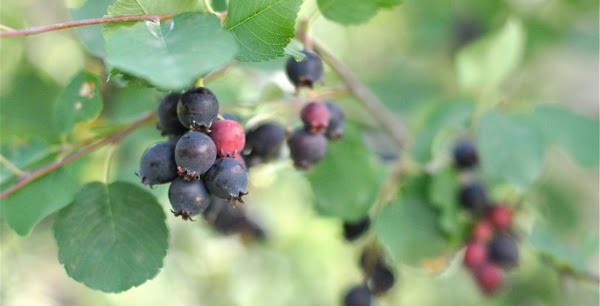
Sassy Saskatoons
Wednesday, August 4, 2010
Purslane Salad
First, a word about weeds. You've heard me extol their virtues before. If you're still a non-believer that weeds can save the world, I insist you try this recipe. Most Americans are busy pulling purslane (Portulaca oleracea—same family as miner's lettuce) right now if they're thinking about it at all—and pulling their hair out, too, because like Himalayan blackberry purslane can never be vanquished. But it can be eaten.
Here's what you do. Pick a bunch of purslane, stem it (making sure to keep many of the leaf clusters intact), and toss it with a chopped sweet onion such as a Walla Walla and a large ripe heirloom tomato. That's it. Season with salt and pepper and allow the tomato juice to form the dressing; squeeze a chunk of tomato into the salad if necessary to get the juices flowing.
You'll be amazed by the results. Purslane has a crunchy texture and a complex flavor that marries perfectly with the acidic tomato juice and sweetness of the onion. Jon Rowley turned me onto this salad last summer at an oyster fest and we ate it again the other day when I dropped by his house to pilfer a few of the shoots for my own garden. Friday, July 30, 2010
Wild Berry Tartlets
It doesn't look like a great red huckleberry year, and first reports coming in from the early-ripening mountain huckleberries near Spokane are not encouraging either. Was it the strange spring weather? The lack of July rain? Maybe it's just a cyclical thing. In any event, the red hucks on Tiger were pretty small and not in abundance, but we made the best of it. Lace demonstrated her finely honed hiking skills by whipping out the backpacker's berry receptacle of choice—a Nalgene bottle—and dexterously filled it in no time.
Red huckleberries (Vaccinium parvifolium) are the first of our many huckleberry species to fruit in the summer, generally preceding their darker cousins by a few weeks. Though found sporadically in the interior as far east as Idaho, they're at their best in the lowland mixed forests of the North Pacific Coast, from Central California up through British Columbia. The west-slope Cascade foothills are good habitat, and the rain forests of the Olympics are loaded with them. The berries are bright fire-engine red and a little more tart than most mountain huckleberries. They look especially good in a fruit salad.
We also found trailing blackberries, the native blackberry of the Pacific Northwest.
After picking and grazing through a series of bushes up and down the trail we headed back toward the parking lot, running into a black bear along the way that was engaged in the same pursuit. The bear eyed us for a moment, then ambled on into the patch, unconcerned.
Lace and I agreed that a tart would be a good choice for the berries. As I've mentioned here before, my baking skills are somewhat suspect so I tend to look for easy recipes. Lo and behold a recipe from Martha Stuart Kids for a simple, unfussy tart dough that can be formed in a muffin tin—right in my wheelhouse! I halved the recipe, since two dozen tarts seemed like overkill, and then set about to make a sweet cheese filling to offset the tartness of the berries.
Tart Dough
1/2 cup flour
3 tbsp cold unsalted butter, cut up
2 tbsp confectioner sugar
2 tbsp cold water
Combine flour, sugar, and butter in a food processor and pulse until grainy. Add the water a tablespoon at a time to food processor while running. Pulse until dough forms. I used my hands at the end to finish combining what the Cuisinart missed. Roll into a cylinder, wrap in plastic, and refrigerate for 30 minutes minimum or up to a day.
Sweet Cheese
1 8-oz package cream cheese, cut into 8 pieces.
6 tbsp sugar
1 large egg yolk
1 1/2 tbsp flour
1/2 tsp vanilla extract
lemon zest of half a small lemon
Combine cream cheese and sugar in food processor. Whir until smooth. Add flour, egg, vanilla, and lemon zest and whir again until creamy.
Berry Topping
1 cup wild berries
2 tbsp sugar
2 tsp corn starch
Briefly cook berries with sugar and corn starch until juices are syrupy.
For the final tarts I took my dough out of the refrigerator and sliced it into a dozen disks. Each disk I flattened into a 3-inch diameter round on a lightly floured surface before pressing into a muffin tin and forming into a cup. Each little tart—tartlet, if I may be so bold—then got a dollop of sweet cheese filling before being topped with a spoonful of the cooked red huckleberries and a few fresh blackberries. I baked the tartlets for around 20 minutes at 400 degrees.
They were met with approval.
Monday, July 26, 2010
Oregon-grape Preserves

The state flower of Oregon looks like holly and grows throughout much of Cascadia. Anyone who spends time in the woods from Northern California up through British Columbia is familiar with its prickly green leaves, bright yellow blooms, and the tart berries that form in clusters in summer. It's not exactly trail food. Pick a few berries on a hike and you'll experience a lip-puckering flavor that gives new meaning to the term sour grapes. But tame it with sugar and you've got a whole realm of culinary possibilities.
Oregon-grape is not a true grape. Though its dark blue berries hang in grape-like clusters, that's where the comparison ends. Members of the family Berberidaceae, the various species of Oregon-grape are also known for their medicinal qualities. The two species commonly encountered in the forests of the Pacific Northwest are the tall Oregon-grape (Mahonia aquifolium) and low Oregon-grape (Mahonia nervosa). Some botanists consider them part of the Berberis genus, which includes a variety of species commonly called barberries and which are renowned for containing berberine, a compound with cancer-fighting and anti-depressant properties, among other medicinal benefits.
To make Oregon-grape preserves wear gloves and harvest a good quantity of the berries. I picked five pounds or so from a patch behind my daughter's pre-K, right in the center of Seattle. Use containers and utensils that won't stain. Wash the berries and remove any large stems or other leafy debris. Put the berries in a pot and add just enough water so that the berries are barely covered. Boil for 15 minutes until soft, then run through a food-mill in batches. The food-mill should separate the juice and pulp from the skins and seeds.
Now you have a choice: You can further strain the juice from the pulp by using cheese cloth or a fine mesh strainer, or you can leave the pulp in to make a preserve more aptly called a spread. Next measure your juice. I had a scant 5 cups. In general you'll want to add an equivalent amount of sugar, give or take depending on your taste. Try mixing in other fruits or berries, too, or even ginger. Bring your juice to a boil and stir in the optional lemon juice and pectin. I used about half of a 1.75 oz package. Next add the sugar, not all at once but slowly, tasting as you go until reaching your preferred balance between tart and sweet. Bring to a boil again, stirring thoroughly, and cook for a few minutes, then remove from heat and immediately ladle into sterilized jars. Process in a hot water bath for 10 minutes.
My measurements:
5 cups Oregon-grape juice and pulp
4 1/2 cups sugar
juice of 1 lemon (optional)
1 oz pectin
Yield: 3 1/2 pints
While Oregon-grape preserves look and taste a lot like your standard grape jelly, the flavor is more complex and full-bodied, with a sweetness that will please children and a tart edge suitable to a grown-up palate. I think it makes a terrific PB&J yet a dollop is equally at home on a fancy cheese plate.
Tuesday, July 20, 2010
Sweet and Sour Geoduck

A recent New York Times article about East Coast clam culture got me wondering: Why no clam shacks around Puget Sound? Day-trip to a beach near New York City or Boston or anywhere along the Jersey Shore and you're bound to stumble on a weathered, low-slung joint where the beer is cold and the clams are fresh. Near Seattle? Not so much. And please, don't try to sell me on Ivar's. The sad truth is we don't have mom and pop clam shacks here, not in any discernible numbers. Population density, I heard someone say, but the Puget Sound region is now pushing five million people, certainly enough to warrant a few well established hole-in-the-wall shellfish shrines.
Another possibility is the clam fare itself. In addition to steamer clams (Mya arenaria, aka Eastern softshells), the Atlantic boasts another species not native to the Pacific, the quahog (Mercenaria mercenaria), and with it an entire category: clams on the half-shell, which is to say raw clams. Out here we mostly do oysters raw.
Still, even if the clams are different you would think the abundance of seafood in the Northwest would promote more than the occasional touristy fish and chip parlor. We have razor clams, littleneck clams, butter clams, horse clams, a variety of oysters, Dungeness crab, spot shrimp, and so on, not to mention the infamous geoduck. An enterprising soul should be able to open a seaside shanty with local beer and lots of seafood and turn it into a destination. You'd think...
I was thinking about this dearth of clam bar culture when I decided I'd bow to the Pacific Rim inclinations of my town and try to marry those leanings to a more down-home greasy spoon approach. I decided to deep fry the remainder of last week's geoduck clam for Sweet and Sour 'Duck.
Let me just say up front that I never order Sweet and Sour anything at Chinese restaurants. That gooey radioactive pink sauce is too weird even for me. But sweet and sour, when done the right way, is a time-honored amalgam of flavors in the Far East and I decided it would make a good match for deep-fried geoduck. I gave a nod to the Americanized version by adding onions and bell pepper. My one big mistake: I added the clams, already fried and crispy, back into the wok at the end to get them thoroughly coated with sauce, which turned them instantly soggy. Bad call! Best to pour on the sauce when you're ready to serve.
1 small yellow onion, chopped
1 red bell pepper, chopped
1 green bell pepper, chopped
peanut oil
1/2 pound geoduck, sliced into thin strips
For Batter:
2 eggs
1/2 cup or more corn starch
For sauce:
3 tbsp white sugar
1/4 tsp salt
2 tbsp black Chinese vinegar
1 tsp soy sauce
4 tsp corn starch
3 scallions, thinly sliced
1 tbsp garlic, minced
1 tbsp ginger, minced
3/4 cup chicken stock
1 tsp sesame oil
1. Prepare sauce ingredients. In a small bowl mix together sugar, salt, black vinegar, soy sauce, and corn starch. Set aside.
2. In wok over high heat, stir-fry onion and bell pepper with a tablespoon of peanut oil for 2 minutes or so, until starting to soften. Set aside and keep warm.
3. Add enough oil to wok to fry sliced clam in batches. Beat eggs and add to corn starch. Batter should be thick; add more corn starch if necessary. Batter and fry sliced clams until golden, then remove to paper towels. Set aside and keep warm.
4. After carefully disposing fry oil, quickly make sauce. Add 3 tablespoons peanut oil to wok over medium heat. Stir-fry garlic and ginger for 30 seconds. Add stock and bring to boil, then add the prepared sauce ingredients. Stir the sauce as it thickens, then add scallions and sesame oil.
5. Serve the vegetables over rice and topped with the fried clam. Pour sauce over.