Showing posts with label plants and herbs. Show all posts

Friday, March 23, 2018

Beef Pho with Licorice Fern

Everyone at the Mekong Market on Rainier Avenue knew what I was up to. The proprietor, a small gentleman always on the move, paused long enough to grin at the two packages of beef bones in my basket and give me the thumbs up. They were a dollar a pound.

Then he frowned when he saw the big bag of dried noodles—and quickly guided me by the elbow to a refrigerated aisle, where he pointed at the fresh rice stick noodles.

At the checkout, as I unloaded a bunch of basil, bean sprouts, a box of yellow rock sugar, and those fresh noodles, the Vietnamese lady in front of me said, "So you're making pho?"

I explained that I had a sick kid at home and this was his request. It was my first attempt. Did she approve of the beef bones?

Indeed. "But make sure to boil out the impurities," she added. This is a common refrain. All my online sources recommend a brief (three to five minutes) initial boil to exorcize from the beef bones what some call impurities and other call, simply, the scum.

I'm all for getting rid of the scum.

Here in Seattle there is likely more pho noodle soup for sale than any other dish. It's our favorite fast food. My kids have grown up with it and have some opinions. I wanted to do it right.

Besides making comfort food for my ailing boy, I also wanted to test an idea that had been percolating in my head for a couple years. There are two ingredients in a typical pho meant to impart a hint of licorice-like flavor, specifically star anise and fennel seeds. Star anise is native to southeast Asia. I wondered if I might use our native licorice fern instead of a spice from halfway around the world. (Read more about licorice fern here.)

I split my batch of pho and designed a simple A-B test: one pot spiced with star anise and the other with licorice fern.

The short answer is that both phos were smashing. The licorice fern, however, won't end up as a local substitute for star anise in my future attempts. Instead, it proved to be yet another possible variation in an eminently malleable dish that's always been a cultural mashup from its earliest beginnings in French-colonial Vietnam.

After testing the two batches, I recombined them. The fern root can't take the place of star anise, but like a stick of black licorice candy, it adds a back-of-the-palate sensation of spicy coolness—a palpable sensation similar to the way Sichuan peppercorn numbs and tingles the lips.

There are plenty of very similar recipes online for pho. Most of them recommend using cut up beef bones (knuckles, shins, etc.) and doing an initial boil to cook out the foam and impurities. This results in a broth that isn't murky. Charring the onions and ginger in the broiler before adding to the broth is another crucial step. I adapted my recipe from this video.

5 - 6 lbs beef bones
6 quarts cold water
2 medium onions, quartered
4-inch piece of ginger, halved lengthwise
1/4 cup fish sauce
1 1/2 tbsp salt
1-inch piece yellow rock sugar
2 cinnamon sticks
1 tbsp coriander seeds
1 tbsp fennel seeds
6 star anise
6 cloves
2 pencil-sized licorice fern roots, peeled and cut into 1/4-inch pieces
thin-sliced beef such as rib-eye, skirt, ti-tip, sirloin, etc.
1 package thin bánh phở rice stick noodles
sprigs of basil, mint, cilantro
bean sprouts
lime
thin-sliced red pepper
sriracha and hoisin sauce

1. In a large stock pot, cover beef bones with cold water and heat over high flame.

2. Meanwhile, heat oven on broil and place onions and ginger in a roasting pan just beneath heat. Roast 15 - 20 minutes, turning occasionally with tongs, until charred on all sides.

3. Toast spices (cinnamon sticks, coriander seeds, fennel seeds, star anise, and cloves) in a dry pan over low heat for 5 minutes, careful not to burn.

4. When stock pot comes to boil, cook 3 minutes so that scum rises to the surface. Drain in sink and rinse bones and pot with warm water. Return bones to pot and cover with 6 quarts of cold water. Bring to boil once again, then reduce heat to simmer.

5. Once broth is simmering, add roasted onions and ginger, fish sauce, salt, yellow rock sugar, toasted spices, and licorice fern. Simmer, uncovered, at least 3 hours. Skim off any scum that rises to surface.

6. Remove bones with tongs, then strain broth through a fine mesh strainer to remove remaining solids. Refrigerate broth overnight to easily separate remaining layer of fat, if desired.

7. To assemble finished dish, add rice noodles and thin-sliced beef to bowl. Cover with hot broth and serve with bean spouts, lime wedges, hot pepper slices, and sprigs of basil, cilantro, and mint, along with condiments such as sriracha and hoisin.


Saturday, April 29, 2017

Wild Ramp Aioli

Every year for Memorial Day weekend our family goes camping with several other families in a beautiful canyon in the rain shadow of the Cascades, where we have a decidedly better shot at some sun.

The food is always over the top. In past years we've barbecued a whole pig, grilled Copper River salmon over the fire, dug holes in the ground for Dutch ovens to make Chicken in the Dirt, and prepared all sorts of appetizers and dinners with our foraged morels and spring porcini.

But the dish that everyone seems to clamor for most is an elaborate concoction of smoked baby potatoes with black garlic vinaigrette and wild ramp aioli. (Ramps are a type of wild leek that grows east of the Rockies.) For years I thought my friend J had invented this carnival of flavors, but it turns out the Danish expat by way of San Francisco picked up the recipe during his Bay Area years, from a little joint you may have heard of called Bar Tartine.

I don't normally have the patience to put all those pieces together into a single dish. Instead I wait for its fireside appearance each spring, knowing J can't go without. The ramp aioli by itself, however, is right in my wheelhouse, so when I got a message from my mushroom hunting pal David saying that some fresh ramps were coming my way, compliments of his employer Earthy Delights, I knew just what to do.

This wasn't my first brush with ramps. I've seen plenty while picking morels back east. Ramps are beloved in the Appalachians, especially in West Virginia where nearly every little mountain town has a ramp festival, and in the northern woods of Michigan. On my last visit to the Upper Peninsula I picked ramps with friends from Marquette. But that was a while ago, and if there's one wild food I wished was native to the Pacific Northwest, the ramp would be near the top of the list.

To make this wild ramp aioli I used pickled ramps. The recipe is a conflation of Earthy Delight's version and Tartine's. You can use fresh ramps, too, and in a few weeks I plan to update this post after using ramps that are currently fermenting in my basement, which is the method that my friend J and Bar Tartine prefer.

3 pickled or fermented ramps*, with tops**
1/2 tsp dried mustard
1/2 tsp peppercorns
1/2 tsp apple cider vinegar
2 tsp lemon juice
1 egg yolk
1/3 cup grapeseed or canola oil
2 tbsp olive oil
salt to taste

1. Place food processor bowl and blade in freezer for 15 minutes if possible.

2. Chop ramps. (I used previously pickled ramp bulbs and fresh tops—see notes below.)

3. Add chopped ramps, dried mustard, peppercorns, cider vinegar, lemon juice, and egg yolk to food processor and process until well mixed together, about 30 seconds.

4. Combine oils and slowly add to processor. Ingredients should thicken to a mayo-like consistency. Continue to add oil. Add salt to taste and more lemon juice or vinegar if necessary.

5. Refrigerate in a tightly sealed container.

Makes enough to fill a 6-oz jelly jar.

The ramp aioli will have the rich flavor and creamy consistency of a typical aioli or mayonnaise, but with the added garlicky bite of wild ramps. Using just the yolk and not the egg white will give it more body. For a chunkier aioli with flecks of bright green ramp tops, don't over-process (unlike mine pictured above).

* Pickled Ramps recipe:

1lb ramps
1 cup white wine vinegar
1 cup water
1 cup sugar
1 tsp mustard seed
1 tsp coriander seed
1 tsp fennel seed
2 tsp mixed peppercorns
1 bay leaf
1 tbsp salt

1. Cut off root tips from ramps and trim leaves, leaving just a little green. Reserve tops for another use. Rinse ramps.

2. Blanche trimmed ramps in a pot of salted boiling water for 30 seconds. Remove and quickly shock under cold tap. Pat dry and place in a pint-sized canning jar.

3. Combine pickling ingredients in saucepan and bring to a boil. Pour over ramps and set aside to cool. Seal tightly and refrigerate up to two months.

** If using fresh ramps for the aioli, cut off the tops (the green leaves) and then blanche the tops in boiling water for 30 seconds, shock under cold tap, and squeeze out excess water before adding to food processor.

Saturday, April 22, 2017

Licorice Fern Liqueur

As I wrote in a recent issue of Seattle Magazine, now is the time to seek out one of the Pacific Northwest's most striking ferns for your summertime mixology needs—before it retires for the year. The licorice fern is a beauty that lives in colonies in mixed lower-elevation forests, often well up in the tree canopy.

I typically see it adorning mossy big-leaf maples, where its roots, known as rhizomes, form an interconnected latticework beneath the moss. It will also colonize suitably moss-covered alders, madrones, and even glacial erratics, those big boulders left over from the last Ice Age that sometimes squat unaccountably in the middle of the woods. The key is finding some within reach.

Licorice ferns in abundance will form green waves undulating through the forest until the heat of summer causes the waves to collapse and the individual ferns to whither away. With winter rains they come back to life: just add water.

The flavor of the root is licorice-like, yes, and also spicy like fresh ginger. Infused in water or vodka, it makes a slightly picante syrup or liqueur that will remind you of the mesmerizing glades of spring licorice fern as you sip a thirst-quenching summer cocktail.

1. Peel and chop a few finger-length pieces of licorice fern root.

2. Cover chopped roots in a half-pint canning jar with vodka (for a liqueur) or water (for a syrup).

3. Refrigerate for two to three weeks, shaking every few days.

4. Strain and measure liquid. Make a simple syrup of equal parts water and sugar that is half the amount of reserved liquid. For example, with my 2/3 cup of fern-infused liquid I made a syrup with 1/3 cup water and 1/3 cup sugar. To make the syrup, boil the water and whisk in sugar until fully dissolved. Allow syrup to cool, then add to reserved liquid.

Licorice fern liqueur can jazz up a refreshing glass of soda water, improve a cheap prosecco, or comfortably join the other esoteric mixers at your cocktail bar.


Monday, April 13, 2015

Clay Pot Bulgogi with Wild Greens

The other day I scouted some of my early morel spots to see if there might be anything starting to pop, given the ridiculously mild winter we've had in the Pacific Northwest. But no, nada. Seems like the fruiting schedule of morels in my area doesn't vary much more than a week no matter how much snow falls in the mountains, although pickers down in Oregon have been talking about morels coming up two weeks earlier than usual in some of their patches.

Nevertheless, I came away with something nearly as good for my effort: wild watercress. Watercress is one of the first spring greens of the season, and depending where you live, it often has a second act in the fall. No doubt there are patches in Northern California that produce much of winter. As I plucked the tender leafy shoots, I already knew what I'd be making.

I mostly use my Korean clay pot for Soondubu, but after ordering a dish simply called "Beef Stew" at a local lunch joint recently I realized it was time to branch out. Unlike a typical American beef stew that requires hours of slow cooking, the Korean version can be whipped together in minutes if you marinate the meat in advance. And the presentation in the clay pot earns extra points. Like those miniature cast iron skillets you see in restaurants that make such a cool presentation of clams or mussels, clay pots are used for both cooking and serving.


With a little prepping, this bulgogi stew is easy. It's essential, however, to marinate the beef for at least an hour beforehand (overnight is even better). I've used various marinade recipes for bulgogi and kalbi ribs over the years, including Bittman's simple version. More traditional recipes call for an Asian pear to help sweeten and tenderize the meat, as in this recipe, although other recipes omit the fruit. As it happens, my local butcher sells thin-sliced beef trimmings already marinated.

A typical clay pot bulgogi will have some sort of leafy green vegetable such as spinach stirred in at the end; this one owes its vibrant color to the wild and very nutritious watercress that's leafing out across much of the country right now.

1/2 pound marinated bulgogi, preferably thin-sliced ribeye (see marinade recipes above)
1/2 small yellow onion, cut into thin slices (add to marinating meat if desired)
1 cup water
1 cup beef stock or dashi
1 handful cellophane sweet potato noodles, about 5 oz
1 green onion, sliced
1 handful fresh wild greens such as watercress, bittercress, dandelions, lambs-quarters
Other optional ingredients: shiitake or enoki mushrooms, sliced carrots, egg

1. Add cellophane noodles to a bowl of warm water and set aside for 20 minutes.
2. Heat clay pot (or conventional pot) over high heat, then add beef and onions and stir-fry a couple minutes until the meat is lightly browned.
3. Add water and stock. If using a clay pot, leave enough room for noodles.
4. Once boiling, stir in pre-softened noodles and cook until tender.
5. When noodles are ready, stir in wild greens and green onion and remove from heat.

Serves 2 with rice.

Tuesday, March 17, 2015

Wild Greens Workshop

It's that time again for those of us on the West Coast. The woods and meadows are waking up. Wild greens—tasty, nutritious, free—decorate the woods and forest fringes.

To ring in the spring harvest, I'll be teaching a foraging and cooking workshop at Heyday Farm on Bainbridge Island on March 27, with a focus on wild spring greens, especially stinging nettles. As I've said here before, nettles are the backbone of my spring foraging. I use nettles in soups, pastas, and sauces, and I put up large quantities of nettle pesto to have on hand year-round.

At Heyday, we'll spend the morning foraging in the woods around the farm, learning about and harvesting what’s in season. Back at the historic Heyday Farm kitchen and farmhouse, we'll learn several ways to pair and prepare our catch. The class will include a satisfying lunch. Cost is $110. Please sign up through Bainbridge Island Parks and Recreation, or by calling (206) 842-2306.


Wednesday, August 27, 2014

The Nagoonberry

I have a favorite new berry. It's called a nagoonberry. Haven't heard of nagoonberries? Well, you're not alone—and you probably don't spend much time in Alaska, where I happen to be right now.

Here in Cordova, just about everyone knows the nagoonberry. And now that I do, too, I could be persuaded to journey north just to get my hands on these delicious "arctic raspberries," never mind the salmon fishing.

The nagoonberry, Rubus arcticus, is a wine-red relative of blackberries and raspberries that grows in northern climates around the world, from Alaska and Canada to Finland, Scandinavia, and Russia. The name comes from Tlingit Indian "neigóon," meaning little jewels that pop from the ground. The low-lying plant, with its three-lobed, serrated leaves, hugs boggy terrain on both the coast and interior of Alaska. They're not prolific, though I've been told that berry-pickers in Cordova gather good quantities for jam, liqueur, and fruit leather. The flavor belies its geographical distribution with a tropical Hawaiian Punch twist on a typical blackberry.

By late August, the pickings around Cordova are slim, but yesterday there were still enough ripe nagoonberries in the wet, mossy meadows just off the roadside to give me a taste of something totally new. And now I'm hooked. These berries are something special and worth seeking out if you're in the North Country.


Tuesday, July 29, 2014

Wild Berry Scones

If you live in the Pacific Northwest and haven't picked your fair share of trailing blackberries and red huckleberries yet…best hurry up. They're mostly done at sea level now, and with this heat they're likely ready to close up shop in the Cascade foothills soon.

I wrote about red huckleberry, Vaccinium parvifolium, earlier this year in Seattle Magazine. Tart and pretty, it's the first of our huckleberries to fruit in the Pacific Northwest. The trailing blackberry, Rubus ursinus, deserves ink too. It's smaller and firmer in comparison to non-native relatives such as the ubiquitous Himalayan blackberry, with a more complex taste profile. Unlike other varieties, trailing blackberries don't grow on upright canes; they snake along the ground and over deadfall  (see photo above), hence their common name.

Together, red hucks and trailing blackberries are a pastry chef's dream team. Both species are usually present in the same woods and ripen at roughly the same time (generally throughout July in my habitat), which means you can target both in a single outing.

Apparently it's a poor year for trailing blackberries, at least on a commercial level. Most of the blackberries I put up for winter are non-native varieties, the Himalayan blackberry in particular, because they happen to be plentiful around where I live, but if I wanted to pick a good quantity of the native variety, I'd head over to the Olympic Peninsula and start poking around in old clearcuts. All blackberries thrive in areas of disturbance (e.g., logged or burned forests, along trails and roadsides, in abandoned lots). The patches with more sunlight will produce heavier crops, which is why old clearcuts are a good choice.

* * *

I usually rely on my mother-in-law for scones. She mails them to us every now and again in carefully packed boxes. But the other day, while taking a group on a wild food ID walk in the foothills, I couldn't get the image of berry-laden scones out of my head, so I went back the next day to collect some of the bounty on colorful display, determined to make my own scones.


I wasn't the only forager in the woods. I see bears in this area every year at about this time, within 20 miles of downtown Seattle. A hiker I met on the trail was concerned about the hand-scrawled warning note (at left). I assured him the bears were too busy enjoying berries to worry about his skinny ass, but he didn't seem convinced.

Here's a recipe for scones that I cobbled together from a few online offerings. Since I didn't have buttermilk, I substituted yogurt whisked with a little milk. If you like sweet scones, add more sugar.

2 cups flour
2 1/2 tsp baking powder
3 heaping tbsp sugar
1/2 tsp salt
1 stick cold unsalted butter
1/2 cup wild berries
1/2 cup yogurt
2 tbsp milk
2 eggs
1/2 tsp vanilla
1/2 tsp lemon zest (optional)

1. Pre-heat oven to 375 degrees.

2. Sift dry ingredients (flour, baking powder, sugar, salt) together into a large bowl.

3. Whisk together wet ingredients (yogurt, milk, and 1 egg) in a medium bowl.

4.  Cut cold butter into small pieces and, using fingers, work into dry ingredients until mealy. Stir in berries, optional lemon zest, and wet ingredients until barely mixed, with a little of the dry flour remaining in bottom of bowl.

5. Remove to a floured work surface. Briefly knead dough so it holds together and forms a disk several inches in diameter and about an inch thick. The dough will be wet and you'll be reminded of making mud pies as a kid—don't fret! Cut a dozen or so wedges out of the disk and place on a greased baking pan. You may need to use a pie knife or spatula to transfer wedges from work surface to pan.

6. Whisk second egg and brush egg wash on wedges.

7. Bake until golden brown and cooked through, about 25 minutes. Cool on wire rack.


Wednesday, July 23, 2014

The Berry Hour

It's berry time. I took a group of would-be foragers out to a state forest the other day, and they were amazed by the diversity of berries available for harvest right now. In fact, I had to crack the whip a few times to keep the gang moving, so entranced were they by the sweet bounty available trailside.

Red huckleberries and trailing blackberries (the native blackberry of the Pacific Northwest, Rubus ursinus) are at their peak. Non-native Himalayan blackberries are ripening in sunny spots and will be abundant in a couple weeks. Thimbleberries are past their peak at lower elevations, but you can go higher and find them in good shape. We also found blackcap raspberries, which I don't see as frequently as some of the other species. A number of others that get overlooked by the average berry picker were ripening in forest openings, such as Oregon grape and salal (pictured at top), and will continue to be available deep into summer; though a challenge to the palate right off the vine, with a little processing and some added sugar, they can make excellent preserves, sauces, and leathers.

If you live in the Pacific Northwest, there's a new book that provides in-depth information on just about all the wild berry-producing plants and trees you're likely to find in the region, native and otherwise. T. Abe Lloyd and Fiona Hamersley Chambers' Wild Berries of Washington and Oregon collects into a single volume more than fifty groups of berry-bearing plants, including well known varieties such as blackberries, raspberries, huckleberries, and serviceberries—and lesser-knowns: hawthorns, crowberries, hackberries, and many more.

I've often wondered about the tempting red berries of the mountain-ash, Sorbus spp. The authors begin their entry on the genus, "The bitter-tasting fruits of these trees are high in vitamin C and can be eaten raw, cooked or dried." Apparently, a number of tribes in my area used them to "marinate meat such as marmot or to flavor salmon head soup," and they're also used in jellies, jams, pies, ale, and a bittersweet wine. The final verdict on edibility: Edible, but not great.

Many others, however, get two thumbs up. The text is sprinkled with recipes for making jams, jellies, syrups, cordials, dressings, leathers, pies, cobblers, and muffins, and the authors also offer updated culinary twists for old standbys such as the Native American energy food pemmican, retooled to use huckleberries or serviceberries mixed with beef jerky and nuts.

Flipping through Wild Berries of Washington and Oregon got me so revved up for summer's bounty that I braved the I-90 floating bridge closure yesterday and visited some of my favorite berry patches. Stay tuned for a Wild Berry Scone recipe next week.

Monday, June 2, 2014

Wild Tempura Udon

Alas, Puget Sound's recreational spot shrimp season came and went without me wetting a pot. I dredged the freezer instead and found a frosty package from last May. And you know what? They were still shrimpalicious.

Spot shrimp (Pandalus platyceros) rank among the great delicacies my region is known for. Year-old crustaceans are not optimum, true, yet these spotties retained the sweetness that is characteristic of the species. Tempura battered and fried, they made an excellent addition to udon.

After learning in April just how easy it is to make a killer udon at home, I've been enjoying this traditional Japanese noodle soup a couple times a week with a variety of foraged greens and mushrooms. This version is my favorite so far. It has three wild ingredients: spot shrimp, oyster mushrooms, and devil's club shoots. (Click here for the basic udon soup recipe.)

I've played with a number of tempura recipes over the years. In general, I prefer to leave tempura to the professionals (and their fry-o-later equipment), but every now and then I get a yen to make it myself. The key is to make sure the batter is wet and runny, which makes for a light and crispy finish. Too thick and the batter will fry up pillowy. This is a basic recipe that can be adapted. For instance, you could add a dash of rice wine or various spices. Experiment with the oil temperature, too. It needs to be hot enough to fry the ingredients rapidly, but not so hot that they aren't cooked through before the exterior browns. Slice ingredients such as sweet potatoes thinly so they cook quickly.

1 cup flour, sifted
1 egg, beaten
1 cup water, ice cold
oil for deep-frying
shrimp and vegetables (e.g., zucchini, sweet potato, onion, mushroom, etc.)

1. Heat oil in a wok or deep saucepan. It's ready when a drop of water sizzles. Adjust heat as you go.

2. Combine flour, beaten egg, and ice water in a large bowl and use chopsticks to mix together. Don't overmix. It's okay to have lumps. And make sure the batter is thin, wet, and runny.

3. Batter and fry in batches, careful not to crowd.

4. Remove to rack or paper towels.


Thursday, May 15, 2014

The Firtini

I see a three-firtini lunch in my future…

Believe it or not, the new growth of many conifers, even pine trees, is edible. Certain species of fir and spruce are the most sought after for their tender and fragrant tips, and in my woods they're showing right now.

Simply chopped and sautéed in butter with mushrooms or potatoes, fir and spruce tips bring the forest right into your kitchen, with wafting evergreen aromas and the evocation of cool mountain shade. Infusions are another crowd-pleaser. You can use the pungent tips to infuse stock, cream, or alcohol. At the Herbfarm I've enjoyed a champagne cordial infused with a small shot of spruce extract.

For this drink, I first turned to The Wild Table for a quick primer on infusing alcohol with Douglas fir tips. Earlier this year I had the good fortune to be seated next to Connie Green at the Oregon Truffle Fest's big dinner. Connie owns Wine Forest Wild Foods in the Napa Valley. Her cookbook collects decades of experience in the foraging and restaurant communities of Northern California. Connie's instructions for infusing vodka with fir tips appear below.

1 cup Douglas fir tips
1 750 ml bottle of vodka

1. In a blender, combine fir tips with 1/3 bottle of vodka and blend for 2 minutes. Pour into a quart-sized jar. Empty remaining vodka into blender, swirling around to capture fir tip residue and add into same jar. Seal jar, shake, and refrigerate for 1 week.

2. Strain fir-infused vodka, first through a fine mesh strainer, then through a strainer lined with folded cheesecloth, and finally through a coffee filter for maximum clarity. The coffee filter will take a while, but this is how to get the most appealing result.*

3. Keep fir-infused vodka in fridge or freezer.

While the concoction was steeping, I checked in with my friend Andrew who has perfected a number of wild liqueurs and tinctures over the years. He advised me to allow the infused vodka to rest in between steps during the straining process, so that floating particulates can settle on the bottom. "The last step [with the coffee filter] may take several hours," he said. "But the end result is totally clean." You're left with a beautifully translucent, evergreen-tinted final batch. Pour this back into your vodka bottle.

To make a Firtini, add fir-infused vodka to a shaker with ice and a splash of elderflower syrup. Garnish with a tip.

* The photo at top depicts a jar of fir-tip vodka that's only a day into the infusion process and hasn't been strained through a coffee filter (I couldn't wait!), resulting in a more opaque cocktail. You can see the settling of the fir sediment in the jar. When ready to strain, don't disturb this settled layer of sediment.


Tuesday, April 29, 2014

Sichuan Pickled Fiddleheads with Ground Pork

The fiddlehead window is closing quick. Seems like they were up a week earlier than recent past seasons, and lowland ferns are mostly fronded out by now. I went higher to get my pickling supply, to about 2,000-ft elevation, and filled a 10-pound bag.

Most of these fiddleheads will be pickled either in an Asian refrigerator style that doesn't require processing (and maintains the bright green color) or this way. That is, once I get around to the odious task of cleaning them.

Some will get cooked too. Simply sautéed in butter is a good strategy. I also like my fiddleheads in Eastern preparations.

I've posted a number of Asian fiddlehead recipes over the years, two of my favorites being the above mentioned quick pickles and Sichuan dry-fried. The recipe here combines elements of both. I used Fuchsia Dunlop's pickling recipe and then stir-fried the pickled fiddleheads with a little ground pork, Sichuan peppercorns, and dried chile peppers (see Land of Plenty).

The result is easily my favorite new fiddlehead recipe.

First, you'll need to pickle some fiddleheads (a minimum half-pound) in the Sichuan style.

Sichuan Pickled Vegetables

1 quart-sized jar with lid
2 1/4 cup water
1/4 cup rock or sea salt
4 dried chiles
1/2 tsp whole Sichuan peppercorns
2 tsp rice wine
1/2 star anise
1 tbsp brown sugar
1-inch piece of unpeeled ginger
1/3 cinnamon stick
1 pound or more vegetables, such as string beans, slice carrot, daikon radish, etc.

1. Dissolve salt in boiling water and set aside to cool.

2. Add pickling spices to jar and add cooled water. Cover and shake to mix.

3. Fill jar with vegetables (e.g., fiddleheads), making sure brine covers them. Tighten lid and put aside in a cool, dark place for a minimum 24 hours; a week is better. You can continue to replenish the jar with vegetables by adding more salt, sugar, and wine.

Pickled Fiddleheads with Ground Pork

1/2 lb Sichuan pickled fiddleheads (see pickling recipe above)
1/4 lb ground pork
1/2 tsp rice wine
1/2 tsp soy sauce
1 tsp salt
2 tbsp peanut oil
3-4 dried chiles, halved and deseeded
1/2 tsp whole Sichuan peppercorns

1. Mix pork with rice wine, soy sauce, and salt in a small bowl.

2. Add 1 tbsp oil to wok over high heat until smoking. Add pork and stir-fry until dry and crumbly, a few minutes. Return meat to bowl.

3. Add 1 tbsp oil to wok over medium heat and quickly stir-fry Sichuan peppercorns and chiles until fragrant, careful not to burn, less than a minute. Add pickled fiddleheads and cooked pork into wok and continue stir-frying another couple minutes. Fiddleheads should remain tightly scrolled; serve before they start to unwind in the wok.

Serves 2 with another dish and rice, or 4 with a few additional dishes.

The other day I stir-fried some fresh fiddleheads in a very different Sichuan preparation, one relying on what is known as a fragrant fermented sauce (based on the mixture of sweet bean paste and soy sauce). This sauce is especially good with a simple stir-fry of beef or pork slivers with thinly sliced bell pepper, a popular dish all over Sichuan Province.

For my improvised version (see above), I stir-fried pressed seasoned tofu cut into cubes along with the fiddleheads, thin-sliced rounds of carrot, and flowering chives cut into 3-inch sections. It was delicious, but now I understand why the fragrant fermented sauce is most frequently encountered with slivers of meat and vegetables. Because of the large and varying shapes of my ingredients, rather than bathed in a comforting brown gravy, they were spotted with oily blots and most of the sauce drained to the bottom of the dish in a dark slick.

At least I have plenty of fiddleheads on hand to continue my experiments with this fleeting taste of spring.


Monday, April 14, 2014

Halibut with Nettle Sauce, Peas & Miner's Lettuce

I love this time of year. The woods are greening up, robins wake me before dawn, and wild foods are everywhere for the harvesting. Last week I found a clutch of fresh young oyster mushrooms sprouting on an alder; the other day I found another bunch in full fruition that was ready for picking. Fiddleheads are up, miner's lettuce is carpeting the ground, and stinging nettles are everywhere.

The miner's lettuce I used for this recipe is growing in a nice urban patch not far from my Seattle home. This is Claytonia perfoliata, not to be confused with the more common variety in Puget Sound, Siberian miner's lettuce, Claytonia sibirica. A few leaves scattered on the plate lend a sharp green note, while spring peas add texture. I like to use fresh shelling peas if possible, but frozen baby peas will do in a pinch. The sauce is quick and easy if you happen to have stinging nettle pesto on hand; I always have some frozen at the ready.

Stinging Nettle Sauce

2 cubes frozen stinging nettle pesto, defrosted
1 tbsp butter
2 tbsp diced shallot
1/2 cup heavy cream

1. Saute shallot in butter in a small sauce pan over medium heat.

2. Stir in stinging nettle pesto.

3. Lower heat and whisk in cream. Thicken to desired consistency, adding more cream if necessary.

For the final dish, ladle stinging nettle sauce and cooked peas into a shallow bowl. Plate pan-fried halibut fillet (see my friend Hank Shaw's tutorial for pan-searing fish) over sauce and garnish with miner's lettuce leaves. This recipe will make enough sauce for 2.

If you've put up quantities of stinging nettles and have some nettle pesto in the freezer, this is a fast restaurant-style meal. The pesto is also ideal for serving kids a quick and healthy pasta too.

Tuesday, August 13, 2013

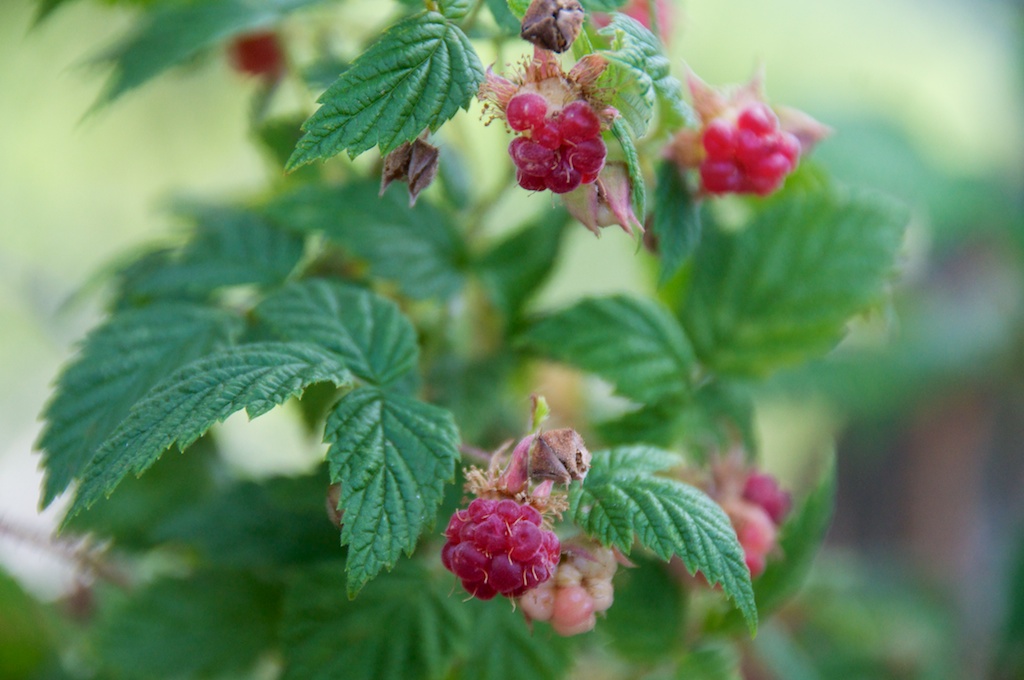
Wild Red Raspberry

Each summer we visit family in the Colorado Rockies, where it's tradition to kick off the trip with a walk up to the same overlook, a place we dubbed the "Bear's Lair" more than a decade ago after spooking a bear from its fern-matted day bed nearby.

The route to the Bear's Lair follows an old hunter's jeep track up a ridge through oak scrub and aspen glades, finally topping out on a knoll covered in spruce and lodgepole pine. Sadly, the large pines are all dead now, victims of the pine beetle epidemic that's ravaged Colorado in recent years, and the forest doesn't offer the same respite from the sun that it once did. But the woods are still painted in wildflowers and home to a herd of elk that moves quietly among the hidden meadows and quaking aspens. From there a quick scramble up a dry, dusty slope and over big boulders takes us to the Lair. A single Douglas fir twists out of the rocks and shades the place. We sit up there and admire the view back across the valley. Sometimes we spot golden eagles circling high in the thermals above.

I've hiked to the Bear's Lair countless times in summer and snowshoed up in winter. It's become a ritual to pay our respects here. Yet, on this trip, for the first time, I noticed a nice little patch of wild red raspberries growing from cracks in the rocks right around the base of the Lair, in perfect fruit. How had I missed these before? Could they have just gotten a foothold?

More to the point: Who doesn't love raspberries? Sweet, tart, soft, delicate. Ruby red. I'm more familiar with the blackcap raspberry (Rubus leucodermis), which we find back at home in sunny spots on both sides of the Cascades, often in areas of disturbance such as logging clearcuts. Blackcaps are dark blue or purple and often mistaken for blackberries; the more widely known form, Rubus strigosus (or Rubus idaeus among those who consider Eurpopean and North American red raspberries to be the same species) looks very much like a typical cultivated variety, if a bit smaller. Unlike a lot of domesticated fruits and berries with wild relatives, the taste of the wild raspberry is very similar to the cultivated.

Wild raspberries seem to prefer marginal habitats and tough growing conditions. As a result, it's a rare day when I find enough of them to make a dessert or put up for later. They're trail food—a tasty jolt of energy while hoofing it through the wilderness. And this day was no different. We ate up all the ripe berries we could find, leaving behind plenty that would be ripe for the local bruins in a few days, taking note of this cache for future visits to the Bear's Lair.

Monday, July 8, 2013

Crazy for Conifers

When beginner mushroom hunters ask me how to find fungi, I have two answers. First, join a mycological society and go on a foray; there's no substitute for spending time in the field with a seasoned pro. The second answer might be more surprising: learn your trees.

Experienced mushroom hunters in southwestern Oregon and northern California know the many culinary treats that hide among roots of Notholithocarpus; boletivores of the Rockies are skilled at locating high meadows dotted with Picea; and don't even get me started on the need—the absolute necessity—to know the habits of Abies grandis if you plan to look for edible fungi on the east slope of the Cascades in springtime.

Knowing your trees is a huge part of the mushroom puzzle. This is because many species of fungi have symbiotic relationships (aka mycorrhizal associations) with trees and shrubs. The fungi and trees exchange water and nutrients, and in some cases the bond is so strong that the fungus will form a protective and permanent sheath around the tree's root tips, a sort of shotgun wedding.

For those of us hunting mushrooms in the western U.S.—in the Pacific Northwest in particular—the trees to know are overwhelmingly conifers. I have a whole library of books about the life histories and identification of trees in my region, and a new one has just found a prominent place among them. Michael Edward Kauffmann's Conifers of the Pacific Slope: A Field Guide to the Conifers of California, Oregon, and Washington is an important addition, and a broader companion to his earlier work, Conifer Country, which focuses on the rich conifer biodiversity of the Klamath Mountain region.

Of the world's 600 or so species of conifer, more than half populate the Pacific Rim, and 65 species can be found along the Pacific Slope of North America. Northwestern California is the epicenter of conifer diversity on the continent. A hike into the Russian Wilderness's "miracle mile" in the Klamath Mountains will reward the conifer enthusiast with potentially 17 (maybe 18) species, one of the richest assemblages on the planet.

Kauffmann has been mentored by some of the best. He dedicates his new book to John O. Sawyer, one of the pioneering botanists of California, who died in 2012. Stephen Arno, whose Northwest Trees has been considered a must-have for tree fanciers since its publication more than 35 years ago, calls Kauffmann's guide "comprehensive" yet "user-friendly." The book is divided into sections for each of the three families represented: Cupressaceae (cypresses, junipers, cedars, and redwoods); Pinaceae (firs, Douglas-firs, spruces, pines, larches, and hemlocks); and Taxaceae (yews). Most species descriptions are accompanied by multiple photos depicting bark pattern, cones, and foliage, along with range maps. Text includes discussion of habitat and other observations and remarks.

Tree geeks will need this book because Kauffmann is generous with information about locating some of the more hard-to-find species. Never seen Picea breweriana, the Brewer spruce? Try driving the Bigfoot Highway near Happy Camp, California. Or the beautiful subalpine larch, Larix lyallii? Hike into Washington's Pasayten Wilderness and check north-facing slopes above 6,000 feet.

It pays to be arbor-aware. Mushroom hunters and foragers in general benefit from recognizing a landscape's tree composition, whether looking for fungi, wild greens, berries, nuts, or roots. Besides, trees are some of nature's most beautiful creations, and recognizing their many forms and life histories makes us all the richer.

Tuesday, June 25, 2013

Saskatoon Berry Sauce

In eastern Washington, wild Saskatoons (Amelanchier alnifolia)—aka western serviceberry, shadbush, and juneberry—grow near the extensive orchards of cherries, apples, and pears that follow the river valleys. The Wenatchee River corridor near Leavenworth is loaded with Saskatoons, and it's interesting to see how this free food is all but ignored while the domesticated fruit trees are bombed with pesticides, tended to by an underclass of migrant workers out of Mexico, and fawned over by tourists.

The other day I picked a good quantity of Saskatoons in view of the orchards while passing motorists wondered what the heck this crazy guy was up to. The paradoxes of modern food culture pile up on our plates...

A Saskatoon sauce is just the thing this time of year to dress up a scoop of good vanilla ice cream. Or you can add some vinegar and herbs to make a savory sauce. Most of the recipes you'll find online are too sweet and use corn starch as a thickener. Don't follow the herd! The berries are plenty sweet on their own, and they'll thicken into a nice sauce with a little extra simmer time and whisking. For a dessert sauce I also like to add a little lemon zest in addition to the juice. Remember that these berries have noticeable seeds. The seeds add a nutty dimension to the flavor, but if you're picky about your texture, you can cook this sauce down (with more time and water) and run it through a food mill or strainer.

2 cups Saskatoon berries
1 cup water
1/4 cup sugar, or to taste
2 tbsp lemon juice
lemon zest, to taste

Bring the berries and water to boil in a sauce pan. Reduce heat and simmer for several minutes. Whisk in sugar, lemon juice, and zest. Continue to simmer and whisk until sauce is thickened to taste. Add more water if necessary.