Showing posts with label kitchen heroics. Show all posts

Monday, January 28, 2013

Truffle Redux

I went back to the Oregon Truffle Festival again this year. It was a no-brainer: wild foods, fun people, and more Willamette Valley wine than a ship of Vikings could put away. What's not to love?

Connie Green, longtime forager and owner of Wine Forest Wild Foods (French Laundry is a client), was one of the featured speakers, and there was the usual fast-paced agenda of lectures, forums, gastronomical heroics, plus a few hours in the field to get dirty, breath in some of that misty Willamette air, and work off all those calories (okay, maybe not all of them) during a guided truffle foray.

Just the way salt is a key ingredient in a good chocolate chip cookie, the success of the Oregon Truffle Festival rests on elements that might, at first glance, seem less than obvious, such as a hard-to-pin-down bonhomie that develops among the attendees. When you're spending two or three days with strangers, you better establish some rapport. All weekend long I found myself exchanging email addresses and phone numbers with an eclectic, sociable bunch of people drawn together to the church of food and drink.

Maybe some of the good vibes came from the success so many enjoyed while digging their own truffles on Saturday. I've said it before and I'll say it again: finding your own food is satisfying and infectious. I saw newbies emerge from the woods with huge grins and handfuls of Oregon white truffles. There were a few dogs on hand to help sniff out the tuberous delicacies, including Chloe, a lab whose master turned out to be John Getz, a professional forager who has been called "the mushroom whisperer."

I first learned of Getz from a DVD that David Arora showed me a few years ago. Arora said it was like watching a magic trick. The video, filmed on the Oregon coast, follows Getz along on his rambling rounds as he appears to pull #1 matsutake buttons, one after another, from thin air. Nowhere is there even the slightest hint of cap emerging from the sandy humus or even a bump in the duff—and yet this soft-spoken guy uncovers buckets of perfect matsi that he might as well have pulled rabbit-like from a hat. Getz laughed when I told him about the video, and offered modestly that it was just a matter of knowing which trees hosted a fruiting. Yeah, that and having a ninja fungal sense and nearly four decades of scouring Pacific Northwest mushroom patches under your belt.

A few food highlights. Saturday's post-foray luncheon, held at Silvan Ridge Winery in the bucolic Lorane Valley and helmed by Jason French from Ned Ludd in Portland and Shiloh Ficek of Red Hills Market in Dundee, kicked off with a Pinot Noir barrel tasting and continued with one of the best dishes of the weekend, a robustly truffled Chicken Liver Mousse (pictured at left) that was perfectly paired with a J. Scott Cellars Roussanne. Ficek told me he was a little nervous about the mousse because usually he made it in smaller batches, but the smooth texture and well-balanced accent of white truffle turned out just right.

French's wood-fired Pork Coppa Sandwich (pictured at right) anchored the meal. It came dressed with quince jam and a black truffle slaw, along with a glass of Silvan Ridge Syrah. It was a beguiling mixture of earthy and domestic, salty and sweet, and succulent and crunchy. The wine pairing was another hit, and I ended up going home with bottles of both the J. Scott Roussanne and a Silvan Ridge Muscat that accompanied a dessert of Black Truffle Pear Crostata, a dish I plan to replicate for a future post.

We got back to the hotel at 4 p.m., with merely two hours of down-time before another feast of even greater proportions, the Grand Truffle Dinner. After taking photos of the first course, which stretched nearly the length of the room on two long prep tables, I went to get my seating assignment and was delighted to find myself next to Clare and Brian, the husband-and-wife team behind Big Table Farm and Wine in Gaston, Oregon. Let me tell you, this was like winning the lottery—like doubling your money in Vegas. Besides the very generous pours (and more pours) that accompanied each course during the meal, the Big Table duo had smuggled in several of their own bottles to share with their tablemates. A big happy table indeed.

Among my favorite dishes at the Grand Truffle Dinner was the first course, a charcuterie plate prepared by Elias Cairo of Olympic Provisions in Portland (pictured at left) that boasted perhaps the most intense truffle experience of the weekend: slices of white truffle-infused saucisson (i.e., dry-cured salami) along with Jamon York, Mortadella, truffled mustard, and some simple yet exquisitely pickled beets and onions. Another winner, dreamed up by Nick Balla from Bar Tartine in San Francisco, was an umami bomb of sablefish, sunchoke, and Kabocha squash, its white truffle broth so good that I saw guests tipping their plates back to drink in every last drop.

A scent of truffles hovered through the ballroom as the dinner went on late into the night and a jazz combo tried to play over the sounds of active silverware. There was much imbibing, and then, late-night, I found myself among a group of revelers laying siege to a 1988 Champagne Fleury while plotting foraging expeditions of the future. Good times.

The Oregon Truffle Festival is held the last weekend of January. I've already blocked out the dates for next year.

Tuesday, March 22, 2011

Italian Nettle Sausage Pie

And I always thought baking was for control freaks. Silly me. Kate McDermott—aka the Pie Lady, dubbed "the rock star of pie" by Seattle Magazine—is not your typical baker. She doesn't worry about humidity or get hung up by exact measurements. She goes against the grain, which is her way. It's more of a Zen thing. "Feel the dough," she likes to say, only half-kidding.

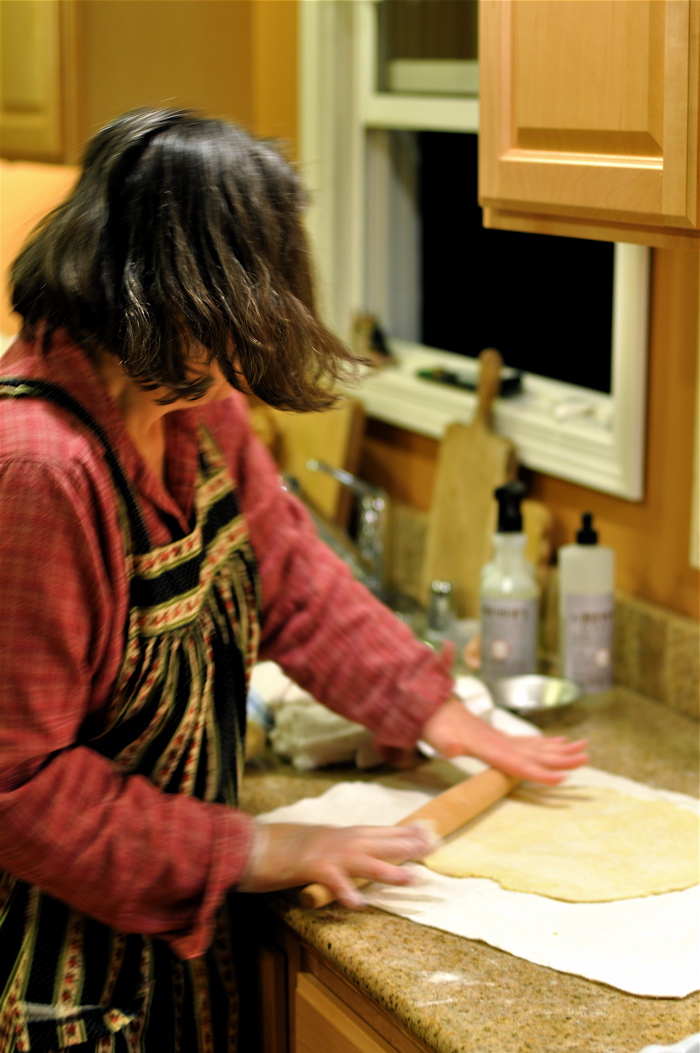
The evening began with a trip out to the chicken coop, where Kate nabbed fresh eggs. Next she unwrapped a tan disc and slapped it on the counter: the dough, just liberated from cold storage. At that moment it could have been dropped at center ice by a man in black and white pinstripes. "Rule number one," she said. "The only rule. Chill out." She handed me a mixing bowl. This, too, was zamboni cold.

Of course, like much of what she says, Kate's admonition to chill has multiple meanings. As I started to roll out my hockey puck of dough she stopped me. I was thinking too much. "I'll change the music," she offered. You need the right music to roll by. The smooth vibes of Seal soared out of Kate's kitchen speakers; I remembered how an old three-pinner friend of mine swore by this record for a fresh foot of powder in the back-country.

Kate's own style of rolling is more along the lines of the whirling dervish variety. She dances to the music, swings her hair to and fro, and belts out an Aretha Franklin chorus during the next song.

This all helps to explain why she calls her business Art of the Pie—as opposed to, say, Science of the Pie. More dionysian than apollonian, Kate's vision is for a world filled with pies, in which pie is merely the starting point for better things to come. "It's a movement," she laughs. Her own part in the movement can be measured by the 50 pounds of leaf lard she goes through each month, the 75 pounds of weekly apples in season, and the hundreds of students who have graduated from her four-hour class with a determination to spread the gospel of pie.

As for me, the proof was, indeed, in the pie, with a crust of flakey perfection and a savory filling that highlighted the brightness of wild weeds. Really, I can't recommend this recipe enough. It's a version of a classic, using stinging nettles instead of spinach, to superior effect. Our tweaks included the addition of leeks, nutmeg, red pepper flakes, and lemon juice.

I learned a lot during this pie-making session, and though I won't go so far as to say my new skills are ready for prime time, Kate has put me on the path to a fresh understanding of baking with her pie-making mojo.

1 pound sweet Italian sausage
4 large cloves garlic, chopped
3 leeks, thinly sliced (discard green tops)
6 eggs
20 oz stinging nettles, blanched and squeezed dry
4 cups shredded mozzarella cheese
1 cup ricotta cheese
1 tsp teaspoon salt
1/4 teaspoon pepper
fresh nutmeg to taste
2 tsp lemon juice
1 10-inch pastry for a double crust pie
1 tablespoon water

1. In a skillet over medium heat, saute sausage, leek, and garlic.

2. Separate one egg and set the yolk aside. In a mixing bowl, beat the egg white and remaining eggs. Mix in nettles, mozzarella cheese, ricotta cheese, salt, pepper, nutmeg, red pepper flakes, lemon juice, and sausage mixture.

3. Line a deep 9 or 10-inch pie dish with bottom pastry (with a 9-inch dish you will likely have leftover filling). Add filling. Cover with top pastry. Trim, seal, and flute edges. Cut slits in top. Beat water and remaining egg yolk; brush over top.

4. Bake at 425 degrees for 20 minutes, then lower heat to 400 degrees for another 30 minutes or until crust is golden brown and filling is bubbly. Let stand for 10 minutes before cutting.

Sunday, March 6, 2011

Wild Indian: Stinging Nettle Paneer & Porcini Chana Masala


Sometimes a kitchen experiment yields better results than you ever imagined, and you feel like Gene Wilder in Young Frankenstein. Happily, my recent creation neither ran amok through the neighborhood nor incited a pitchfork mob—though it did get a wild applause from my dinner guests.

I'm talking about my Stinging Nettle Paneer. The dreaded stinging nettle, as most of us have known since childhood, is a monstrous weed. It's invasive and hard to eradicate, and woe to those who try to drive it from civilization, because the nasty barbs pack a painful wallop. On the other hand, with a little love and understanding, the nettle becomes an ideal food. It's one of the first greens of spring (late winter for many of us) and loaded with nutrients.

Most people I know who like Indian cuisine have a special place in their hearts for Saag Paneer, the creamy spinach curry with fried cheese. After all, spinach is good for us and even a decadent presentation feels somehow virtuous. Try this recipe with stinging nettles and you'll simultaneously welcome the weed and never feel quite the same about Saag Paneer again.

Substitute stinging nettles for spinach? Really? Believe me, you'll wonder whether this dish was originally invented with the belligerent weed in mind. The nettles leave the spinach in the dust. They're so bright in flavor, with a wild sweetness that goes perfectly with the Indian spices. My dinner guests were blown away and so was I. This dish goes to the top of the list of stinging nettle recipes.

Stinging Nettle Paneer

3/4 lb paneer, cut into cubes
1 large onion
3-4 cloves garlic
1 4-inch thumb of ginger, peeled
2 tbsp vegetable oil, plus extra for frying paneer
3-4 cardamom pods, crushed
1/2 tsp cumin seeds
1/4 tsp ground cinnamon
1/8 tsp ground cloves
1-2 plum tomatoes, diced
20 oz boiled nettles, drained
1/2 tsp turmeric
1 tsp ground cumin
1 tsp ground coriander
1 heaping tsp garam masala
1 tsp black pepper
1-2 tsp salt
1 cup, more or less, heavy cream or yogurt or a mix
cilantro for garnish

1. In a food processor, pulverize the onion, garlic, and ginger into paste.

2. Over medium heat, saute paste in oil for a few minutes in heavy-bottomed saucepan. Add cumin seeds, cardamom, cinnamon, cloves, and tomatoes, and cook for a minute or two, stirring occasionally.

3. Squeeze out excess water in boiled nettles. You'll have a clump about the size of a baseball. Chop up by hand or with a food processor; I like mine well chopped, but not overly pulverized.

4. Add nettles to pan, along with tumeric, cumin, coriander, garam masala, black pepper, and salt. Stir together well.

5. Meanwhile fry paneer cubes in a little oil until lightly browned, then add to nettle mixture just before serving.

6. Finish over low heat with heavy cream or yogurt to desired consistency. Garnish with fresh cilantro.

***

I've been working through my store of frozen wild mushrooms all winter. With spring porcini season around the corner, it seemed like a good time to use up the freezer supply and make room for a new batch. Mushrooms work well in any number of Indian curries; I especially like their addition to this Chana Masala, where they provide an added textural dimension, not to mention mushroomy flavor.

For this dish I turned to Michael Natkin's recipe over at Herbivoracious for the spice regime. Toasting your spices in oil is a traditional way to extract full flavor, but you want to be extra careful not to burn the spices. The toasted black mustard seeds, in particular, are a must.


Porcini Chana Masala

1/2 pound porcini mushrooms (or cremini), roughly chopped
1 can (14 oz) chickpeas, drained
1 medium onion
3-4 cloves garlic
1 4-inch thumb fresh ginger, peeled
2 tablespoons vegetable oil
2 teaspoons black mustard seeds
1 teaspoon fennel seeds
1 teaspoon cumin seeds
1 teaspoon coriander seeds
1 can (14 oz) diced tomatoes, drained
1 teaspoon ground turmeric
1/4 teaspoon ground cinnamon
1/8 tsp ground cloves
1/4 tsp cayenne pepper
1 tbsp lemon juice
1 tsp salt
1 tbsp brown sugar (optional)
1 cup (or more) water, stock, cream
cilantro for garnish

1. With a food processor make a paste with onion, garlic, and ginger.

2. Heat oil over medium heat in a large skillet. Add black mustard, fennel, cumin, and coriander seeds, and toast until mustard seeds start to pop (about 30 seconds or so). Note: do not overcook spices in oil or the curry will be bitter. Immediately add paste and tomatoes. Cook until liquid evaporates and mixture begins to brown.

3. In a separate pan, saute mushrooms in a little oil or butter until lightly browned. Add to skillet along with chickpeas. (I used previously sauteed and frozen porcini, and added directly after thawing.)

4. Add turmeric, cinnamon, cloves, cayenne pepper, lemon juice, salt, and a cup or so of water if necessary.

5. Cook uncovered over medium-low heat for 15 minutes. Adjust seasonings.

6. I finished my curry with a tablespoon of brown sugar and a half can (about a cup) of coconut milk, for a slightly sweeter curry. Garnish with fresh cilantro.

Cooking Indian at home can seem like a recipe for failure. All those spices! If you're new to Indian cuisine, the first step is to visit your local spice store. You'll want to have the basics: turmeric, cumin seeds, cardamom pods, ground coriander, garam masala, and so on. The amount of spices and seasonings will be overwhelming at first, but a little practice and before long you'll be making your own adjustments to once-obscure seeming spices in a given recipe based on personal preference.

Wednesday, April 21, 2010

Laksa: One Word, One Pot, One Heckuva Meal


Ten years ago Marty and I traveled to Borneo, with stops in mainland Malaysia and Singapore. Besides trekking through primeval rainforest, watching a pageant of colorful songbirds from high up in the canopy, and hanging out with endangered orangutans in their diminishing habitat, we also ate bowlfuls of the region's signature one-pot meal.

Laksa is thought to be the centuries-old creation of Chinese traders living in Malaysia. The country has long been a crossroads for a variety of Asian cultures. Ethnic Malays, Chinese, and Indians make up the bulk of the population, and their representative cuisines intermingle to give Malaysia a wide-ranging national menu. It's only just, then, that Laksa has gone on to be much more than a Malaysian specialty. Versions of it are found all over Southeast Asia—indeed, all over the world, with those determined globetrotters the Australians particularly enamored of it. Within Malaysia itself there are countless variations, from the slightly sour tamarind-based Sarawak style found on Borneo to the rich coconut "Curry Mee" of Penang.


In fact, trying to sort out the many variations and their devoted adherents is a trip down the rabbit hole that I don't intend to make. The important thing to know is that Laksa is delicious, many-layered, and filling. (Apparently the name Laksa translates as "ten thousand"; whether this refers to the number of ingredients in the paste or the amount of condiments required is unspecified.) In its most basic form, Laksa is a curry-like soup ladled over noodles. Chicken along with seafood such as shrimp and squid are the most common meats added to the pot. In parts of Malaysia and elsewhere a type of cockle called the blood cockle (because it bleeds red) is considered an essential ingredient, as is congealed pig's blood. Other typical ingredients include fried tofu puffs and the usual pho-style garnishes: basil, Vietnamese mint, lime, bean sprouts, and so on.

I rediscovered Laksa while contemplating my haul of cockles the other day. The cockle is something of a problem mollusk. It has great flavor but it can also be tough and chewy—and its stomach of dark green half-digested algae is definitely not a turn-on for most diners. I usually chop up cockles for chowders. Grinding for Clam Cakes is another possibility.

While searching for new cockle recipes online, I stumbled upon a reminiscence of eating hawker Laksa in Singapore. The island city-state of Singapore off the southern tip of the Malay peninsula is known for its "street hawker" food. One can spend a lifetime roaming the markets and stalls and sampling an ever-changing parade of Laksa, with no two bowls tasting quite the same. Unfortunately, I only had 24 hours in this food-lover's paradise, though it was enough to know I will be back. The hawker Laksa reference sent me on a bit of wild hare, both down memory lane and through the Internet's culinary matrix, until my head was dizzy with possibilities. In the end I decided to try my hand at the dish with no single recipe but rather a cherry-picking of ingredients and methods. Certainly you can make all sorts of substitutions and additions. This is merely a start.

Laksa Paste

First you need Laksa paste. If you're in a hurry you can always buy a jar of pre-mixed paste, but part of the fun is the mad scientist approach to mixing and matching an odd assortment of ingredients found at your local Asian market. Combine the following in a food processor and whir until finely blended:

3 shallots, peeled
3 hearts of lemon grass (the lower white part)
5 hot red chilies, stemmed and seeded to taste
4 slices of galangal
1 thumb ginger, peeled
5 cloves garlic
1/4 cup fresh cilantro
1/2 red bell pepper
2 tsp shrimp paste
1 tbsp brown sugar
1 tsp ground turmeric
1 tsp paprika
4 tbsp peanut oil

Add more peanut oil if necessary. The red bell pepper is my addition. I like its sweetness and it lends a richer, warmer color to the final product. Refrigerate leftover paste in a glass jar.

Laksa for 4

1 cup Laksa paste
2 tbsp peanut oil
4-5 cups stock or water
1 can coconut cream (or less)
2 dozen cockles, shelled, cleaned, and cut into bite-size portions
1 dozen shrimp, shelled (reserve shells)
1 package fried tofu puffs, cut into cubes
1 lb rice noodle and/or egg noodle, cooked
garnish: Thai basil, Vietnamese mint, cilantro, green onion, bean sprouts, lime wedges, diced peppers, chopped peanuts, fried shallot

1. Saute reserved shrimp shells in peanut oil over medium heat until slightly browned; remove with slotted spoon. Next add paste and cook, stirring, a few minutes, careful not to burn.
2. Raise heat and add stock (I used chicken), bring to boil, reduce heat and simmer several minutes.
3. Stir in coconut cream. Add cockles, shrimp, and tofu. Simmer another few minutes until shellfish are done.
4. Divide noodles into bowls. Ladle soup over noodles and garnish.

Lastly, prepare to enroll in 12-step Laksa addiction center.

Friday, March 5, 2010

Go for the Gold


This past Sunday I was faced with a tough choice: catch the last two periods of the gold-medal hockey game between the U.S. and Canada or go for the golden razor clam. I went for the gold. It's almost always better to be a participant rather than an observer, don't you think? Unless we're talking about alligator rasslin' or something.


So far this season I had been shut out of razor clam openings because of scheduling conflicts. My luck was about to change. It was a perfect afternoon for a dig: partly cloudy with sunbursts, not too windy, low tide at 6:30 pm. Really, it doesn't get much better than that, not on the storm-swept shores of the North Pacific. By 4:30 the beaches started crowding with people, though not excessively so. It was still mild outside and some of the bolder clammers wore nothing but shorts and t-shirts. My friends Chris and Lori, who star in the morel hunting chapter of the book, set off down the beach with faithful hound Buddha.


Meanwhile surf clamming specialists collected first dibs as the rest of us waited for the tide to drop. This is something I want to learn, mainly because it looks so ballsy to be out there in the foam and spray digging beneath a foot or two of water. How do they even locate the shows? I don't know but there must be some secret shared by the confederacy of surf diggers. Unfortunately I forgot to get a picture of any of them. Maybe they don't even show up on film.

The rest of us used our clam guns (shovels and tubes) to score a few early clams while waiting for the drop. Then, all of sudden, the out-going tide exposed the honey holes. Shows appeared all around. Crazed digging and lots of "Over there!" and "Right behind you!" exhortations. Limits filled in minutes. It was a good crop, with many decent-sized razors and easy digging. Virtually everyone had a limit before the turn.

As I walked back to the van a line of cars and trucks sped past on the hardpan beach, people hanging out of open windows yelling and hollering and generally whooping it up. "Waaaahhhhoooooo!" a long-haired freak zinged me as his buddies hauled him away from the beach in an old Dodge wagon gone to rust. They probably had a hundred razors between them. I flashed him the thumbs-up as he rolled off down the flats. It bears repeating that human beings enjoy getting their own food from places other than the supermarket. Another gift from the sea had been gladly accepted and it was time to party.

Tempura Razor Clam Sushi


If you've spent any quality time in Jamaica, then rolling sushi ought to be second nature. If not, just practice. A bamboo roller makes it easier. How you cook the rice is key. Make sure you use sushi-grade short-grain rice and rinse it in a few changes of water before cooking. The rice should spread smoothly on a sheet of nori without becoming too gloppy.

While the rice is cooking, prep and arrange your ingredients. I've used all kinds of fish, fresh vegetables, Asian-style pickled vegetables, and other flavors and textures. The following are examples, but experiment on your own. Tempura is fun because it adds a little crunch to your sushi and a hit of that fatty goodness that only fried foods can give.

4-5 razor clams, cut in half lengthwise
tempura batter (here's a recipe)
2 cups sushi rice
seasoned rice vinegar
1 package nori
Dungeness crabmeat or other fish or shellfish*
1 small jar tobiko
1/2 cucumber
1 avocado
pickled ginger
wasabi
soy sauce

* Note: As you can see from the photos, I used fake crab, known as surimi, but subsequent review of the Sustainable Sushi web site reveals that surimi is no longer considered a viable option for the sushi lover. On the other hand, Seafood Watch's Sustainable Fish Guide application for the iPhone calls it a "good alternative." This is confusing and should be sorted out.

1. Make rice. When cooked, mix in a splash of seasoned rice vinegar to taste.
2. Peel and slice cucumber into matchsticks. Cut avocado into thin slices.
3. Batter razor clams and fry in oil. Remove to paper towels.
4. Spread rice evenly on nori wrapper. Repeatedly wetting fingers in a dipping bowl makes this easier.
5. Arrange ingredients and roll. For an inside-out roll, flip rice-covered wrapper onto wax paper, rice side down.

Itadakimas!


Turns out my Canadian friends got to revel in their medal victory. But I had my own gold. We grabbed a few pints at the Porthole Pub in Ocean Shores and then made tracks back to Seattle, Winterland '73 cranked in Cora's hippie van. After enjoying a wonderful dinner recently at West Seattle's Mashiko, one of only a handful of certified sustainable sushi restaurants in the world, I had ideas for my catch: Pacific Gold, a fine rolling sushi if there ever was one.

Tuesday, February 16, 2010

Winter Is the New Spring: Nettle Gnocchi


Inhofe and his ilk can bury their heads in the D.C. snow and deny climate change, but here in the Pacific Northwest we just experienced the warmest January on record. Not the warmest in 10 years, not the warmest in a generation—the warmest since scientists first started keeping track, going back to 1891 in the case of Seattle. This is just one of many indicators—from melting glaciers in the Cascades to the changing migration patterns of birds, butterflies, and fish—that a degree or two of rising mercury is remaking the planet in dramatic ways.

The results of our balmy mid-winter beach break have been painfully clear, so to speak. Stinging nettles in the lowlands are already at harvestable size, with some well over a foot tall. I harvested my first batch on February 8. That's two weeks earlier than my previous earliest date. In fact, this year I could have found tender young nettles of six inches or so at the end of January.

To re-phrase an old saw, if the world gives you stinging nettles, make Nettle Gnocchi.

Whenever I make a potato-based gnocchi (as opposed to semolina-based) I'm always skeptical until the little pillows are safely plated and intact. So much can seemingly go wrong (though it usually works out). I improvised on the same recipe as the one for Oxtail & Porcini Gnocchi, which is based on a recipe from 101 Cookbooks. But after making gnocchi a handful of times in the past year I can say that recipes for potato dumplings are more like guidelines. The important thing is to get a feel for the dough. I don't think I've ever used the same amount of flour twice, and this is especially true when adding a wet ingredient such as boiled nettles to the mix.

So think of the amounts below as estimates. The best thing to do is start with less than the full cup of flour and then keep adding. You may end up using well over a cup as I did.

2 large Yukon Gold potatoes, boiled and peeled
1 egg, lightly beaten
1 cup nettles, boiled and chopped
1 cup or more flour
salt to taste

1. Boil nettles for a minute or two to neutralize sting. Remove to cold water. Next wring out excess water. Chop nettles, measure out a cup and then whir in a food processor.

2. Cut potatoes in half and boil in salted nettle water until tender, thirty minutes or more. Remove from water one at a time and peel. Break down potatoes with a fork and allow to cool. Make sure to attack lumps but don't over-mash.

3. Mix nettles into potatoes by hand, a little at a time.

4. Sprinkle a handful of flour over your work space. Pull potato-nettle mixture into a mound on floured surface and make a volcano-like crater. Pour beaten egg into crater and sprinkle 3/4 of the flour over top. Start working the dough with metal spatulas or your hands, adding more flour and folding the dough into itself as you go. I find this step gets messy unless I make sure to use plenty of flour.

5. Split the dough into 5 or 6 balls. The dough is ready when you can easily roll out each ball into a long snake. Again, a work surface dusted generously with flour makes this easier. Now cut into pillows.

6. Add gnocchi to salted boiling water. (You can re-use your nettle-potato water.) When they float to the surface they're done. Remove with a slotted spoon.

I ate my Nettle Gnocchi with two different sauces. A simple red sauce with grated parm works quite nicely, the acidity of the tomatoes marrying well with the high green note of the nettles.

But even better, in my opinion, is—surprise!—a sweet, herbed cream sauce. I know, my love for the cream sauce seems to know no bounds. Just trust me. For this more decadent preparation, try briefly sauteing fresh chopped herbs from the garden (I used sage, thyme, rosemary, oregano, parsley, and chives) in butter, splashing with a little cognac that bubbles off (but not before leaving a pleasant sweetness), and finishing with heavy cream. Pour over the gnocchi and sprinkle with parmesan. As you can see from my picture below I was in a bit of a hurry to eat this meal. I used half-and-half, which separated somewhat from the butter. Still, it was an amazing lunch.

Wednesday, August 12, 2009

Salmon Head Soup


"When the buffalo are gone, we will eat mice, for we are hunters and must have our freedom." - Chief Sitting Bull

Wouldn't you know the day I forget my camera is the day my boy catches his first salmon off the beach—on a Snoopy rod no less. (The photo at left is his second salmon off the beach, taken the next day. He's looking a little more blasé about the whole thing.)

Riley let out a whoop when the fish hit his lure, and I'm sure I probably thought it was a false alarm, some weeds or a bottom snag. But then I saw the Snoopy rod doubled over. Next came the yelling and screaming and carrying on. Other anglers on the beach interrupted their casts to take notice of the commotion. I ran over and set up a station behind the boy, making sure the fish didn't rip the rod right out of his grip. He reeled and kept the tip up like a pro. Pretty soon the fish was in the surf and I figured for sure it would break the line. But Riley held on and pulled that salmon right up onto the beach. The kid knows what to do.

We ate the fillets in two sittings. The heads I saved for something special.

My kids are big soup eaters. Because we live near Seattle's International District, at a tender age they discovered noodle houses and the "subtle yet profound" pleasures of an Asian noodle soup, as one blogger has jokingly put it, parroting cooking shows like "Iron Chef." These soups are so tasty and cheap that I never really considered trying to make my own before, but after reading Hank Shaw's post on the "nasty bits" of fish, I just had to give it a shot. Besides, we're fishermen here at FOTL. When the salmon are gone I suppose we'll fish sculpin; in the meantime we can do honor to our catch by eating every last morsel.

I haven't cooked many fish head soups. None in fact. Luckily we have the Interwebs from which to draw on a nearly bottomless well of inspiration. Two recipes in particular, in addition to Hank's, informed my final improvisation: [eating club] vancouver's Mama's Fish Head Soup is home cooking at its best, and gave me the courage to use canned Szechuan prepared vegetables; a column by Steve Barnes from Albany, N.Y.'s Times Union convinced me that the double-strain was the way to go, and that aromatics such as green onions and cilantro would give the broth extra depth when applied after the first straining.

The advice was good. I have to say, if you'll allow me, this soup was every bit as good as soups I've had in the I-District. Those of little faith might get spooked during the proceedings, especially when the salmon heads are rolling around in there with the leeks and other stuff, going to pieces and spraying their bones about willy-nilly. But that's what the strainer is for. Ever glanced into the kitchen of a back alley noodle house? Not a good idea. But all the crazy stuff going into that bubbling cauldron will eventually get strained out, leaving—yes—a subtle yet profound broth in its place.

Hank's Salmon Head Soup is in the Japanese tradition. We like that—but my kids are most enthusiastic about the many varieties of Chinese noodle soup, so I went down to Uwajimaya to see what ingredients I could dig up. Sure enough, they had the sketchy can of Szechuan prepared vegetables (some sort of radish, I think). I also got some udon noodles, our nod to the Japanese style. Here are the ingredients in full:

2-3 salmon heads, cut in half
2 tbsp peanut or vegetable oil
1 tsp sesame oil (optional)
1 3-inch thumb of ginger, peeled and sliced
2 leeks, tops discarded, chopped
4 green onions, chopped
4-5 cloves garlic, chopped
2 Thai red peppers, thinly sliced
Chinese cooking wine
2 tbsp fish sauce (optional)
rice vinegar (optional)
aji-mirin (optional)
1 can Szechuan prepared vegetable (optional)
1 can bamboo shoots
1/2 head Napa cabbage, shredded
1 handful cilantro for garnish, stemmed, with stems reserved
1 package Asian noodles (e.g., udon, soba, ramen)

Despite the long list and the double strain, this is actually a fairly easy soup to make without the sort of pitfalls that can bedevil other soup recipes.

1. Over medium-high heat, brown fish heads and ginger in oil for a few minutes, turning at least once. De-glaze pot with a splash of wine and add chopped leeks, garlic, and half the green onions and red peppers. Saute together for several minutes.

2. De-glaze pot again with another splash of wine, then add 8 cups of water and optional fish sauce. Bring to a light boil, reduce heat, and simmer for 30 minutes.

3. Strain contents, picking and reserving as much salmon meat as possible. Return soup to simmer. Adjust for salt. Add half the remaining green onion and the cilantro stems. (Optional seasoning: Add a tablespoon of each: Chinese wine, rice vinegar, aji-mirin; add a few heaping tablespoons of Szechuan prepared vegetables.) Simmer another 15-30 minutes.

4. Strain soup a second time and return to low heat to keep warm. Dole out reserved salmon meat into bowls, along with noodles, a handful of shredded cabbage, and spoonfuls of both Szechuan prepared vegetables (optional) and bamboo shoots. Ladle soup. Garnish with green onion, cilantro, and Thai red pepper. Serves 4.

Prepared Szechuan vegetables will be hard to find unless you have access to an Asian market. If you can find 'em, I highly recommend. I also recommend the optional seasoning, though you'll be tempering the fish flavor in the process. A second strain with green onions and cilantro stems (or similar aromatics) is de rigeur; this is where the umami effect really kicks into high gear. If you've eaten in a quality noodle house, you know what I'm talking about. How do they do it? I once wondered, savoring every last drop of broth in my bowl.

Now I know.

Tuesday, June 2, 2009

Fillet Mignon with Devil's Club Bordelaise and Wild Wood-Sorrel


Here at FOTL headquarters we've been known on occasion to indulge in lunches that might be described as unfair, over the top, or generally not in line with a proper upbringing—and that's mostly without martinis! What can I say? It's called "working from home."

Last week, for instance, there was vanilla ice cream with homemade chocolate sauce to break up the heat of the day. This week—i.e. just a few minutes ago—witnessed a plating of fillet mignon for the afternoon repast. Connecting both these luncheons, besides sheer indulgence, was a nasty barbed plant familiar to hikers and bushwhackers throughout Cascadia: the treacherous devil's club.

My experiments with devil's club have just started. So far I've learned that the newly emerged buds of this native plant, with their strong aroma of conifer forest and wet woodland, can be used for both sweet and savory dishes alike to bestow a depth of character and regional identity. Last week, sweet. This week, a nod to the other side of the aisle. I adapted a bordelaise recipe from Saveur, opting not to make my own demi-glace (10 pounds of veal bones anyone?), going with Demi-Glace Gold instead.

The wild wood-sorrel, probably Oxalis oregona, came from a patch found near Tiger Mountain during a pit stop with the kids on the way home from camping in the Teanaway this past weekend. Oxalis isn't actually sorrel (Rumex sp.), but this shamrock-looking groundcover has a similar tart, lemony taste due to oxalic acid, earning it the common name (one of many) of wood-sorrel. While you shouldn't eat it in large quantities because the acid can cause gastric distress, in a salad or as a garnish it offers a sharp counterpoint to sweet and unctuous dishes.

1/2 cup red wine
1 sprig fresh thyme
1 shallot, finely diced
1 bay leaf
3-4 tbsp demi-glace
1 heaping tbsp fresh devil's club buds, chopped
2 6-oz. filet mignons
salt and pepper, to taste
1 tbsp canola oil
1/2 tbsp chilled butter, diced
1/2 tbsp fresh parsley, chopped
1/2 tsp fresh rosemary, chopped
1/2 tsp fresh thyme, chopped
1 bunch wild wood-sorrel, de-stemmed

1. In a saucepan, combine wine, thyme sprig, shallot, and bay leaf over medium-high heat. Reduce wine until almost evaporated, then add most of chopped devil's club. Cook another minute, stirring. Discard the thyme and bay leaf. Stir in demi-glace. Cover, remove from heat, and set aside.

2. Prepare the filets: Heat oven to 500 degrees. Season filets with salt and pepper. Heat oil in a 10-inch skillet over high heat. Sear steaks, flipping once, until browned, about 2 minutes per side. Transfer skillet to oven and roast until steaks are cooked to taste, about 4–5 minutes for rare. Set aside on a plate.

3. Sauce the steak: Return saucepan to medium heat. Whisk in butter and remaining pinch of devil's club. Scrape skillet bottom for drippings and add a spoonful to sauce. Remove saucepan from heat; stir in parsley and season sauce with salt and pepper. Transfer steaks to cutting board; add juices from plate to pan and stir. Spoon 2 tbsp sauce onto each plate. Slice steak into 1/4"-thick slices. Sprinkle with rosemary and thyme. Serve with wild greens such as watercress or wood-sorrel.

Initially I was worried that watercress would have made a better pairing with the meat, but as it turned out the tartness of the wood-sorrel was just the ticket for giving a fresh punch of greenery to what is otherwise a very rich dish. And the devil's club is an ideal way to temper this richness further and expand it with a cool taste of the woods. Serve with a full-bodied red.