While I was out skiing around the neighborhood this morning, my daughter Ruby was busy cooking down a cup of frozen huckleberries with water and sugar, then blending it in the Vitamix. After a quick straining she had a deep red, sweet and syrupy liquid to pour over packed snowballs—a perfect treat for a no-school Snow Day.
Monday, February 4, 2019
Huckleberry Snow Cone
While I was out skiing around the neighborhood this morning, my daughter Ruby was busy cooking down a cup of frozen huckleberries with water and sugar, then blending it in the Vitamix. After a quick straining she had a deep red, sweet and syrupy liquid to pour over packed snowballs—a perfect treat for a no-school Snow Day.
Tuesday, July 29, 2014
Wild Berry Scones
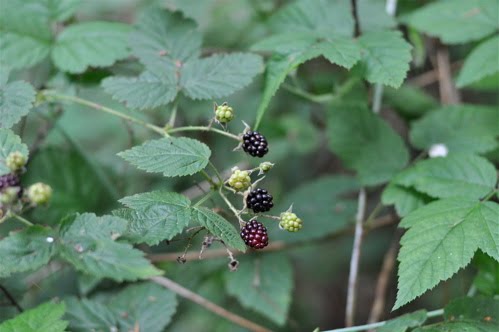
Apparently it's a poor year for trailing blackberries, at least on a commercial level. Most of the blackberries I put up for winter are non-native varieties, the Himalayan blackberry in particular, because they happen to be plentiful around where I live, but if I wanted to pick a good quantity of the native variety, I'd head over to the Olympic Peninsula and start poking around in old clearcuts. All blackberries thrive in areas of disturbance (e.g., logged or burned forests, along trails and roadsides, in abandoned lots). The patches with more sunlight will produce heavier crops, which is why old clearcuts are a good choice.
I usually rely on my mother-in-law for scones. She mails them to us every now and again in carefully packed boxes. But the other day, while taking a group on a wild food ID walk in the foothills, I couldn't get the image of berry-laden scones out of my head, so I went back the next day to collect some of the bounty on colorful display, determined to make my own scones.
I wasn't the only forager in the woods. I see bears in this area every year at about this time, within 20 miles of downtown Seattle. A hiker I met on the trail was concerned about the hand-scrawled warning note (at left). I assured him the bears were too busy enjoying berries to worry about his skinny ass, but he didn't seem convinced.
Here's a recipe for scones that I cobbled together from a few online offerings. Since I didn't have buttermilk, I substituted yogurt whisked with a little milk. If you like sweet scones, add more sugar.
2 cups flour
2 1/2 tsp baking powder
3 heaping tbsp sugar
1/2 tsp salt
1 stick cold unsalted butter
1/2 cup wild berries
1/2 cup yogurt
2 tbsp milk
2 eggs
1/2 tsp vanilla
1/2 tsp lemon zest (optional)
1. Pre-heat oven to 375 degrees.
2. Sift dry ingredients (flour, baking powder, sugar, salt) together into a large bowl.
3. Whisk together wet ingredients (yogurt, milk, and 1 egg) in a medium bowl.
4. Cut cold butter into small pieces and, using fingers, work into dry ingredients until mealy. Stir in berries, optional lemon zest, and wet ingredients until barely mixed, with a little of the dry flour remaining in bottom of bowl.
5. Remove to a floured work surface. Briefly knead dough so it holds together and forms a disk several inches in diameter and about an inch thick. The dough will be wet and you'll be reminded of making mud pies as a kid—don't fret! Cut a dozen or so wedges out of the disk and place on a greased baking pan. You may need to use a pie knife or spatula to transfer wedges from work surface to pan.
6. Whisk second egg and brush egg wash on wedges.
7. Bake until golden brown and cooked through, about 25 minutes. Cool on wire rack.
Wednesday, July 23, 2014
The Berry Hour
Red huckleberries and trailing blackberries (the native blackberry of the Pacific Northwest, Rubus ursinus) are at their peak. Non-native Himalayan blackberries are ripening in sunny spots and will be abundant in a couple weeks. Thimbleberries are past their peak at lower elevations, but you can go higher and find them in good shape. We also found blackcap raspberries, which I don't see as frequently as some of the other species. A number of others that get overlooked by the average berry picker were ripening in forest openings, such as Oregon grape and salal (pictured at top), and will continue to be available deep into summer; though a challenge to the palate right off the vine, with a little processing and some added sugar, they can make excellent preserves, sauces, and leathers.
If you live in the Pacific Northwest, there's a new book that provides in-depth information on just about all the wild berry-producing plants and trees you're likely to find in the region, native and otherwise. T. Abe Lloyd and Fiona Hamersley Chambers' Wild Berries of Washington and Oregon collects into a single volume more than fifty groups of berry-bearing plants, including well known varieties such as blackberries, raspberries, huckleberries, and serviceberries—and lesser-knowns: hawthorns, crowberries, hackberries, and many more.
I've often wondered about the tempting red berries of the mountain-ash, Sorbus spp. The authors begin their entry on the genus, "The bitter-tasting fruits of these trees are high in vitamin C and can be eaten raw, cooked or dried." Apparently, a number of tribes in my area used them to "marinate meat such as marmot or to flavor salmon head soup," and they're also used in jellies, jams, pies, ale, and a bittersweet wine. The final verdict on edibility: Edible, but not great.
Many others, however, get two thumbs up. The text is sprinkled with recipes for making jams, jellies, syrups, cordials, dressings, leathers, pies, cobblers, and muffins, and the authors also offer updated culinary twists for old standbys such as the Native American energy food pemmican, retooled to use huckleberries or serviceberries mixed with beef jerky and nuts.
Flipping through Wild Berries of Washington and Oregon got me so revved up for summer's bounty that I braved the I-90 floating bridge closure yesterday and visited some of my favorite berry patches. Stay tuned for a Wild Berry Scone recipe next week.
Saturday, August 31, 2013
Know Your Vacciniums
And so it is with huckleberries. In the Pacific Northwest there are at least a dozen species of Vaccinium, and it pays to recognize them all. There are early fruiting huckleberries (the red huckleberry, Vaccinium parvifolium) and late fruiting huckleberries (evergreen huckleberry, Vaccinium ovatum); there are tart, bright blue huckleberries that make good jam (Vaccinium ovalifolium) and nearly black huckleberries (Vaccinium membranaceum) that taste great right off the vine. There's a huckleberry that colonizes wetter habitats (Vaccinium deliciosum) and one that can be found high in the mountains (Vaccinium caespitosum). Read this post for more tips on huckleberrying.
The other day I visited my patch of Vaccinium membranceum. This is the main species picked and sold commercially. It's big, which makes for faster picking, and sweet. It goes by various common names including thin-leaf huckleberry, globe huckleberry, and mountain black. This is a decent year for V. membranaceum and I would encourage my readers in the Greater Pacific Northwest to search it out. Right now! It's common in the mountains of Washington, Oregon, Idaho, western Montana, and British Columbia, with more localized populations south to California and east to the Upper Great Lakes.
We freeze as many huckleberries as we can pick, and eat them year-round. As I say in Fat of the Land, huckleberries are a baker's wet dream. The balance between sweet and tart is ideal for pastries, and they make the best pies, cobblers, crisps, and tarts.
But we're not the only members of Mammalia with a sweet tooth for Vaccinium and its allies. Ursus americanus and Ursus arctos horribilis are fans, too, so be prepared to share!
Monday, July 22, 2013
Summer Berries
On Sunday I took a class berry-picking on Bainbridge Island. Whereas two years ago on the same date we had bushes overflowing with red huckleberries and even salmonberries, this year the red hucks were already long past their prime and there wasn't a single salmonberry in sight. The sunny spots still had a few trailing blackberries, and we found one patch of blackcap raspberries. I watched a towhee skillfully nabbing huckleberries on the wing, a hint of where all the berries had gone.
Nevertheless, we managed to pick enough huckleberries to make berry tartlets (see recipe here) back at the park center, putting a sweet exclamation on a day pleasantly divided between field and kitchen.
Saturday, November 17, 2012
A Forager's Thanksgiving
Here in the Pacific Northwest, we're lucky to have a climate that allows for foraging year-round, even during the dark, wet days of late fall and winter. If you're hoping to include a few wild foods in your Thanksgiving feast, keep reading...
Wild Mushrooms
By late November, those of us in Washington need to think more strategically about our mushroom hunting spots. The bread-and-butter golden chanterelle harvest is mostly done by this time, the surviving specimens oversized, floppy, and waterlogged. Skiers own the mountains now and even many low-elevation habitats should be ruled out because of recurring hard frosts. Head for the coast or the southern Olympic Peninsula and look for microclimates where fungi can persist. Search out those hardier winter species such as yellowfoot chanterelles and hedgehogs. Hint: they prefer moist, mossy forests and plenty of woody decay.
If you're willing to travel, make tracks for southwestern Oregon where kings and matsutake are still available. My favorite this time of year, though, is the black trumpet, which is just starting to fruit and can be found in mixed forests with oak. Sautéed in a little butter, it tastes just like fall.
Shellfish
We're coming into the high time for shellfish. The summer spawn is over and the clams, mussels, oysters, and crabs are putting meat back in their shells, rather than using their fat reserves for reproduction.
Many a Nor'westerner likes to give a regional twist to the Turkey Day dinner, including a shellfish course of soup or stew, or simply a mess of Dungeness crabs on the table to kick off the proceedings. I try to dive for my crabs when I can, though the seafood market is a dry alternative. One year I made a Dungie crab bisque for twenty. It was time-consuming peeling all that crab—I'd recommend shelling out (pardon the pun) for lump crab meat instead—but oh so decadent and delicious. Unfortunately, by the time the labor-intensive bisque was ready, I think many of us were too deep into a Northwest wine tasting to fully appreciate it.
An elegant, tomato-based shellfish stew in the Italian tradition is a great way to charm your guests and add European flair to the American meal. I make one chock full of clams, mussels, shrimp, scallops, and squid (note: Seattle's public fishing pier is host to a multi-lingual party of midnight squidders this time of year that is not to be missed). You can find my shellfish stew recipe in Fat of the Land. Or try a simple New England-style Clam Chowder, of which I have a couple recipes, here and here. Steamed littleneck clams can be easily gathered and prepared in minutes. A splash of white with a few sprigs of parsley and couple smashed garlic cloves is all it takes, or you can add a bit more prep time for Clams with Herbed Wine Sauce. Don't forget crusty bread for dipping.
The South Sound and Hood Canal are good options for digging littleneck clams and picking oysters, while razor clam digs on the sandy ocean beaches are a time-honored way to stock the larder. In Oregon, Tillamook and Netarts bays are popular with clam diggers. Check the state Fish & Wildlife web sites for information on beach openings and limits.
Greens
Some of our spring weeds reappear in fall with the cool weather. One of the better bets is wild watercress, which can be gathered in quantity and tastes so much better than its domesticated counterpart. Spice up your green salad with watercress, pair it with wild mushrooms in a stuffing, or make a soup or side dish with it.
Berries
We're lucky to have a dozen varieties of huckleberry in Washington and Oregon. Our late ripening variety is the evergreen huckleberry, Vaccinium ovatum, and it's often available right around Thanksgiving. Of all the huckleberries, it's one of the easiest to pick, with sweet berries that can be pulled off the branches in bunches, so get your fill, though be warned: as with our fall mushrooms, this is not a good evergreen huckleberry year. Should you find some, there's nothing better than a huckleberry pie or cobbler to put an exclamation mark on a wild Thanksgiving meal.
Saturday, October 13, 2012
Wild Berry Sorbet
The weather, or lack of it, has been tough on the region's commercial foragers. Normally golden chanterelles and porcini are the focus this time of year. Instead, the pickers have been extending the huckleberry harvest.
My own freezer is filled with bags of huckleberries, too, and blackberries. My daughter can't get enough for smoothies, yogurt parfaits, panna cotta, coffee cake, and other treats. These are the go-to uses for berries in our family, in addition to my own favorite, cobbler. Looking for something new, I turned to Foraged Flavor by Tama Matsuoka Wong for inspiration. Wong is the house forager for New York's Daniel restaurant, part of Daniel Boulud's empire. With help from the restaurant's chef de cuisine, Eddy Leroux, she's given the usual dirt-under-the-fingernails foraging book a more culinary twist. Arranged by season, Foraged Flavor is a catalogue of wild foods (with an East Coast emphasis) and recipes that have passed muster in Manhattan's cutthroat dining scene.
"Although sometimes startling and sharp," Wong writes in the introduction, "a wild taste is often more complex...with a symphony of flavors and notes. Similarly, wild plants look and act more like individuals, as they have not been airbrushed or altered to sit on a supermarket shelf like Hollywood stars." Amen.
Most foraging books are identification guides that dwell on the finding rather than the cooking. Wong's book takes a different approach with its focus on cuisine. True, the book comes with color plates in a DK style and helpful notes on habitat and key characteristics. But it is the scores of recipes, more than eighty in all, that will make this a dog-earred addition to the forager's bookshelf.
The recipes are spare and simple, highlighting the arresting flavors of the foraged ingredient. There are several variations on salads (e.g., Cardamine Cress with Fennel and Orange Vinaigrette), dips (Garlic Mustard Eggplant Dip), and syrups (Pineapple Weed Syrup). Some of the recipes that have caught my eye, earning a bookmark for later: Curried Lamb and Lambsquarters Meatballs, Sweet and Sour Daikon Radish with Crushed Juniper Berries, and Candied Violet Flowers.
Say the authors on their recipe for Wild Berry Popsicles: "The rich and layered blend of berry tastes make this an out-of-the-ordinary treat." If you're lacking in popsicle moulds, make a sorbet instead, as I did with an equal mix of huckleberries and blackberries.
1 cup sugar
1/2 tsp vanilla extract
3 cups wild mixed berries
1. In medium saucepan, bring to boil 2 cups water, sugar, and vanilla extract. Remove from heat.
2. In a blender, puree the berries and then add the sugar syrup. Blend together until smooth (about 2 minutes). Strain through fine mesh or cheesecloth. Spoon into moulds and freeze until solid, at least 4 hours.
Manhattan may have a highly critical restaurant clientele, but this simple sorbet got the thumb's up from the most exacting berry aficionado I know.
Friday, November 11, 2011
Huckleberry Egg Custard
I surprised Ruby with my huckleberry haul when she got home from school. We made egg custards for dessert and topped them with the fresh hucks. To be honest, I had never actually made an egg custard before, but after eating one of Donald Link's creamy, southern-style custards this summer while he was visiting Seattle for his "Taste of Place" webcast, I knew I wanted to add this simple dessert to the repertoire.
For that custard, Chef Donald used red huckleberries we picked together in the Cascades foothills in the middle of summer. Here it was nearly the end of mushroom season and we were still able to forage fresh huckleberries. This is a good example of why it's useful to recognize a variety of species in any particular genus. In Washington State we have 13 species of Vaccinium. Those in the know can pick ripe huckleberries as early as July and as late as December.
The evergreen huckleberry (Vaccinium ovatum) is an important species for us West Coasters. It's a lowland coastal variety, and it's usually the last of the huckleberries to fruit, often when other species are covered in snow. Clearcuts are a good place to find them, and anywhere else where they can get ample sun. They fruit in clusters, which means the picking is faster than it is with red huckleberries or mountain varieties. Some pickers use a bucket and simply shake the huckleberries off the branch.
More than likely, when you get your evergreen huckleberries home you'll also have a potpourri of twigs, leaves, and maybe a spider or two. The easiest way to clean your berries is to place them on a tray in batches, angle the tray slightly downward toward a colander, and start massaging the berries with the open palm of your hand. Roll them around so they part with their stems. Clean berries will roll down the tray and collect in the colander. Smashed berries, stems, and forest debris will remain on the tray.
The egg custard itself is simple as can be.
1 cup evaporated milk
1 cup water
4 egg yolks
1/3 cup sugar
1/4 tsp salt
1/2 tsp vanilla extract
1/2 cup huckleberries
fresh nutmeg or cinnamon, grated to taste
1. Pre-heat over to 325 degrees. Combine milk and water in a small saucepan and bring to boil.
2. Mix egg yolks, sugar, salt, and vanilla together in a bowl.
3. Slowly whisk in hot milk-water mixture until frothy. Pour into 4 ramekins.
4. Place ramekins in an oven-proof dish or tray filled with warm water. Bake for 40 minutes. Carefully place a small handful of huckleberries atop each custard and bake another 10 minutes. Test one for doneness with a knife tip; if it comes away clean, the custard is done. Sprinkle with fresh nutmeg or cinnamon. Serve hot or cold.
Monday, September 19, 2011
Mountain Huckleberries
This year isn't looking like a banner huckleberry harvest in the North Cascades, but anything is better than last year. Last year the bears got into all kinds of trouble in town because the huckleberry crop failed so miserably. This year the bears should be a little more content. At least my go-to spot had ripe berries on the bush the other day, if not good quantities. Last year the only reason to go huckleberrying was to find porcini under the bushes.
Per usual, I spread the hucks on cookie sheets and popped them into the freezer for a couple hours. Once the berries were frozen I scraped them into freezer bags. This way we can reach into a bag and grab a handful whenever the need strikes. This need strikes my daughter quite frequently. She's a huckleberry fiend, so I need to get back up into the mountains soon or she's liable to get ornery. You don't want an ornery huckleberry-hankering six-year-old at home. It's like having a bear loose in the house.
Thursday, August 25, 2011
Red Huckleberries with Chef Donald Link
Thursday, September 2, 2010
Huckleberry Streusel Coffee Cake
The judges included everyone in my immediate household, and while we sampled lots of delicious coffee cakes that did donuts around my humble Buckle, I suspect it was Lorna's topping that finally gave her the edge, especially with the young judges here at FOTL Headquarters.
Click here for Lorna's Huckleberry Streusel Coffee Cake recipe.
Full disclosure: I know Lorna, who writes for Seattle Magazine and is a regular on the local food scene. But her recipe delighted my kids, and for that she is the winner. Thanks to everyone who entered—and please accept my apologies for having to wait until now to find out who won. At least huckleberries are now fresh and in season for those who want to try the winning recipe.
Photo at top by Lorna Yee.
Friday, July 30, 2010
Wild Berry Tartlets
It doesn't look like a great red huckleberry year, and first reports coming in from the early-ripening mountain huckleberries near Spokane are not encouraging either. Was it the strange spring weather? The lack of July rain? Maybe it's just a cyclical thing. In any event, the red hucks on Tiger were pretty small and not in abundance, but we made the best of it. Lace demonstrated her finely honed hiking skills by whipping out the backpacker's berry receptacle of choice—a Nalgene bottle—and dexterously filled it in no time.
Red huckleberries (Vaccinium parvifolium) are the first of our many huckleberry species to fruit in the summer, generally preceding their darker cousins by a few weeks. Though found sporadically in the interior as far east as Idaho, they're at their best in the lowland mixed forests of the North Pacific Coast, from Central California up through British Columbia. The west-slope Cascade foothills are good habitat, and the rain forests of the Olympics are loaded with them. The berries are bright fire-engine red and a little more tart than most mountain huckleberries. They look especially good in a fruit salad.
We also found trailing blackberries, the native blackberry of the Pacific Northwest.
After picking and grazing through a series of bushes up and down the trail we headed back toward the parking lot, running into a black bear along the way that was engaged in the same pursuit. The bear eyed us for a moment, then ambled on into the patch, unconcerned.
Lace and I agreed that a tart would be a good choice for the berries. As I've mentioned here before, my baking skills are somewhat suspect so I tend to look for easy recipes. Lo and behold a recipe from Martha Stuart Kids for a simple, unfussy tart dough that can be formed in a muffin tin—right in my wheelhouse! I halved the recipe, since two dozen tarts seemed like overkill, and then set about to make a sweet cheese filling to offset the tartness of the berries.
Tart Dough
1/2 cup flour
3 tbsp cold unsalted butter, cut up
2 tbsp confectioner sugar
2 tbsp cold water
Combine flour, sugar, and butter in a food processor and pulse until grainy. Add the water a tablespoon at a time to food processor while running. Pulse until dough forms. I used my hands at the end to finish combining what the Cuisinart missed. Roll into a cylinder, wrap in plastic, and refrigerate for 30 minutes minimum or up to a day.
Sweet Cheese
1 8-oz package cream cheese, cut into 8 pieces.
6 tbsp sugar
1 large egg yolk
1 1/2 tbsp flour
1/2 tsp vanilla extract
lemon zest of half a small lemon
Combine cream cheese and sugar in food processor. Whir until smooth. Add flour, egg, vanilla, and lemon zest and whir again until creamy.
Berry Topping
1 cup wild berries
2 tbsp sugar
2 tsp corn starch
Briefly cook berries with sugar and corn starch until juices are syrupy.
For the final tarts I took my dough out of the refrigerator and sliced it into a dozen disks. Each disk I flattened into a 3-inch diameter round on a lightly floured surface before pressing into a muffin tin and forming into a cup. Each little tart—tartlet, if I may be so bold—then got a dollop of sweet cheese filling before being topped with a spoonful of the cooked red huckleberries and a few fresh blackberries. I baked the tartlets for around 20 minutes at 400 degrees.
They were met with approval.
Monday, February 8, 2010
The Great FOTL Huckle Buckle CONTEST!

Patience is not one of my virtues. This I know. I also know that I will probably never muster the patience required to be a good baker. Unlike most cooking, baking is all about exact measurements. Good bakers improve on a given recipe based on trial and error and careful observation. They learn precisely how to adapt to local conditions of humidity, temperature, elevation, etc. Keeping a log of each attempt—what went right, what wrong—is the sort of smart attention to detail that any good baker employs. I keep no such log.
And so, unless I change my ways, my occasional stabs at baking will almost always be less than earth-shattering. The numinous alchemy between sugar, butter, and flour will remain obscure to me. This is where you come in, gentle reader.
See the recipe for Huckle Buckle below? It hails from an ancient spiral-bound edition of the Better Homes & Gardens New Cook Book. The "new" cracks me up. Martha must have liberated this copy from her grandmother's collection. The recipe is a standard coffee cake with blueberry topping (huckleberry in this household). It's okay, not great. The baking time seems to vary. Rarely do I get the topping synched up with the fluffy cake part, and sometimes the fluffy cake part ain't so fluffy. But it could be really good, I'm sure of that, with some tweaks and additions. After all, what's not to like? Huckleberries and coffee cake should be a killer combo.
Your mission, should you accept it, is to improve upon this recipe—or come up with another one. If the latter, it should be recognizable as a sort of coffee cake (because I like coffee cake) and use either huckleberries or blueberries. I'll award two prizes, which will be a jar of pickled sea beans or fiddleheads for the lucky winners: one prize randomly selected from all the entrants and one prize for my choice of best recipe. Be warned that overly complicated recipes will have a strike against them from the get-go ('cause I'm no champion baker, remember). It might take me a while to try all the recipes, so be patient (wait, you're bakers—you're already patient!).
One last thing: Please use frozen or canned huckleberries or blueberries. We all love fresh, but most of the year we use berries we've put up.
You can email me your recipe (finspotcook AT gmail dot com) or post in the comments field. Include contact info. Contest ends on February 28, 2010. I'll compile the recipes for a future post.
My So-So Huckle Buckle
Batter:
1/2 cup shortening
3/4 cup sugar
1 egg
2 cups sifted all-purpose flour
2 1/2 tsp baking powder
1/4 tsp salt
1/2 cup milk
Topping:
2 cups huckleberries or blueberries *
1/2 cup sugar
1/2 cup sifted all-purpose flour
1/2 tsp ground cinnamon
1/4 cup butter
In large bowl cream shortening and 3/4 cup sugar. Add egg and beat until light. In separate bowl mix together flour, baking powder, and salt; add to creamed mixture along with milk. Spread in greased 11 X 7-inch pan. Top with berries. Mix 1/2 cup sugar, 1/2 cup flour, and cinnamon; cut in butter until crumbly. Sprinkle over berries. Bake at 350 degrees for 45 minutes or until done. Let cool for several minutes, then slice. Serve warm.
* We use two different techniques when using frozen berries. If the berries are frozen in a clump, we thaw and drain them; if individually frozen we add them to the batter without thawing.